
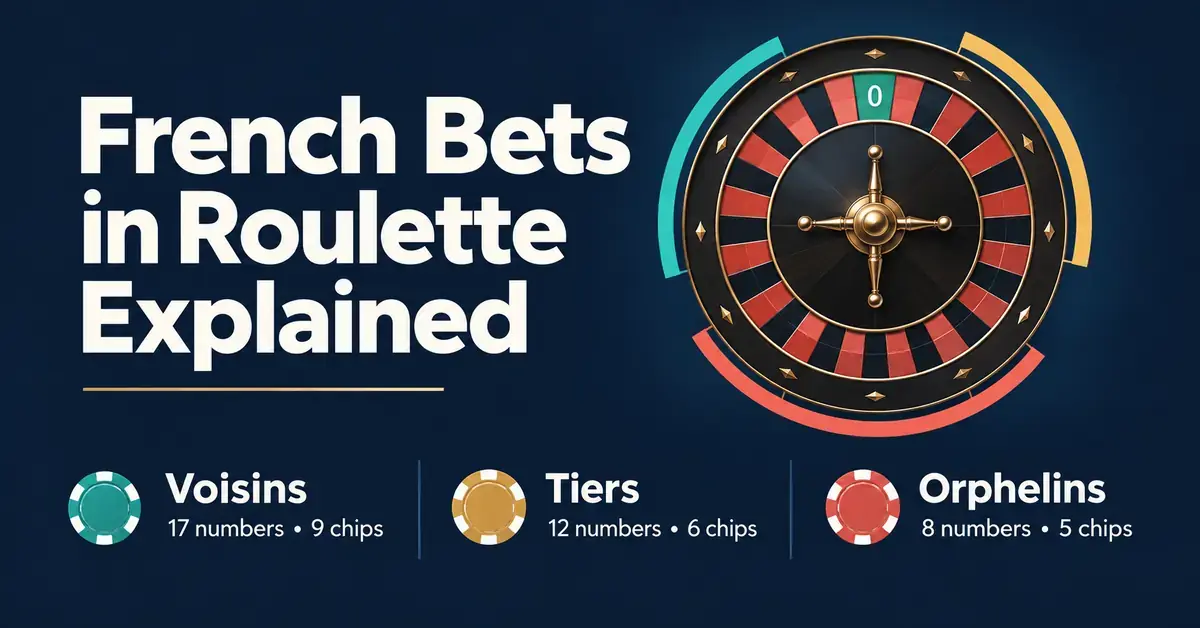
French bets — also called call bets or announced bets — are a group of pre-set wagers that follow the physical layout of the roulette wheel rather than the printed grid of numbers on the table. Instead of betting on one number or a single colour, you cover a whole section of the wheel at once using a fixed pattern of chips. The three classic French bets are Voisins du Zéro, Tiers du Cylindre and Orphelins. This guide explains, in plain English, exactly which numbers each one covers, how the chips are laid out, what you win when they land, and what these bets do (and do not) change about your odds.
Key Points
- French bets follow the wheel layout, not the table grid, and are placed as fixed chip patterns on a single-zero (European) wheel.
- Voisins du Zéro covers 17 numbers around the green zero using 9 chips (wins ~45.9% of spins).
- Tiers du Cylindre covers 12 numbers on the opposite side of the wheel using 6 chips (~32.4%).
- Orphelins covers the 8 leftover “orphan” numbers between the two sectors using 5 chips (~21.6%).
- All three carry the same 2.70% house edge as any other single-zero bet — covering more numbers does not lower the edge.
- A call bet (announced without chips down) is restricted in some markets; an announced bet (chips placed at once) is the legal norm.
What are French (call) bets?
A standard roulette table lets you place chips on the numbered grid — a single number, a split between two, a corner of four, and so on. French bets are different: they are named, ready-made combinations that mirror where the numbers sit around the wheel, not the table. Because the numbers on a wheel are scattered (1 is nowhere near 2, for example), these bets let a player cover a continuous arc of the wheel with a single instruction to the dealer.
You will hear two terms used almost interchangeably, but they have a technical difference:
- Call bet: the player announces the bet without immediately putting the chips down — effectively betting on credit. This is banned in some regulated markets (for example the UK) because no money is on the table when the wheel spins.
- Announced bet: the player announces the bet but places the chips at the same time. This is the legal norm and the version you will meet in most Canadian and online casinos.
French bets only exist on the single-zero (European or French) wheel, which has 37 pockets numbered 0 to 36. If you are new to the game, start with the fundamentals on the roulette-guide.ca homepage before working through the sectors below.
The single-zero wheel and its three sectors
Read clockwise from the green zero, the European wheel runs: 0, 32, 15, 19, 4, 21, 2, 25, 17, 34, 6, 27, 13, 36, 11, 30, 8, 23, 10, 5, 24, 16, 33, 1, 20, 14, 31, 9, 22, 18, 29, 7, 28, 12, 35, 3, 26 — and back to 0. The three French bets simply carve this ring into pieces:
- Voisins du Zéro takes the big arc around the zero.
- Tiers du Cylindre takes the arc on the opposite side of the wheel.
- Orphelins mops up the two small groups left between the other two — the “orphans”.
Together the three bets cover every number on the wheel except a small overlap, which is why they are often taught as a set.
Voisins du Zéro (Neighbours of Zero)
Voisins du Zéro is French for “neighbours of zero”. It is the largest of the three bets, covering the 17 numbers that sit around the green pocket.
Numbers covered
0, 2, 3, 4, 7, 12, 15, 18, 19, 21, 22, 25, 26, 28, 29, 32 and 35 — that is 17 of the wheel’s 37 pockets, so the bet wins on roughly 45.9% of spins (17 ÷ 37).
Chip layout (9 chips)
- One chip on each of five splits: 4/7, 12/15, 18/21, 19/22 and 32/35.
- Two chips on the trio 0/2/3.
- Two chips on the corner 25/26/28/29.
What it pays
Because the nine chips are spread unevenly, your return depends on which number lands (each “unit” below is one of your nine chips):
- Any of the five splits pays 17:1 on its single chip, returning 18 units — a net profit of 9 units.
- The 25/26/28/29 corner carries two chips and pays 8:1, returning 18 units — again a net profit of 9 units.
- The 0/2/3 trio carries two chips and pays 11:1, returning 24 units — a net profit of 15 units, the biggest single payout in the bet.
Tiers du Cylindre (Thirds of the Wheel)
Tiers du Cylindre means “third of the wheel”. It covers the block of numbers on the far side of the wheel from zero, and it is the tidiest of the three bets because every chip goes on a split.
Numbers covered
5, 8, 10, 11, 13, 16, 23, 24, 27, 30, 33 and 36 — 12 numbers, so the bet wins on about 32.4% of spins (12 ÷ 37).
Chip layout (6 chips)
One chip on each of six splits: 5/8, 10/11, 13/16, 23/24, 27/30 and 33/36.
What it pays
All six chips sit on splits paying 17:1, so every winning number returns 18 units for a flat net profit of 12 units, whichever of the twelve numbers lands. Its even, predictable return is why Tiers is often the first French bet beginners try.
Orphelins (Orphans)
Orphelins means “orphans”. These are the eight numbers left stranded in two small arcs between the Voisins and Tiers sectors — the leftovers that neither of the big bets reaches.
Numbers covered
1, 6, 9, 14, 17, 20, 31 and 34 — 8 numbers, so the bet wins on about 21.6% of spins (8 ÷ 37). This is the smallest and least frequent of the three sector bets.
Chip layout (5 chips)
- One chip straight up on 1.
- One chip on each of four splits: 6/9, 14/17, 17/20 and 31/34.
What it pays
- A win on the straight-up number 1 pays 35:1, returning 36 units — a net profit of 31 units.
- A win on any single split pays 17:1, returning 18 units — a net profit of 13 units.
- The number 17 is special: it sits where two splits overlap (14/17 and 17/20), so if 17 lands, both splits win and you collect 36 units — a net profit of 31 units, matching the straight-up 1.
Comparison
| Bet | Numbers covered | How many | Chips | Wheel coverage | House edge |
|---|---|---|---|---|---|
| Voisins du Zéro | 0, 2, 3, 4, 7, 12, 15, 18, 19, 21, 22, 25, 26, 28, 29, 32, 35 | 17 | 9 | ~45.9% | 2.70% |
| Tiers du Cylindre | 5, 8, 10, 11, 13, 16, 23, 24, 27, 30, 33, 36 | 12 | 6 | ~32.4% | 2.70% |
| Orphelins | 1, 6, 9, 14, 17, 20, 31, 34 | 8 | 5 | ~21.6% | 2.70% |
| Jeu Zéro (bonus) | 0, 3, 12, 15, 26, 32, 35 | 7 | 4 | ~18.9% | 2.70% |
Related announced bets to know
The three main French bets are not the only named wagers on a single-zero wheel. You may also come across:
- Jeu Zéro (Zero Game): a smaller cousin of Voisins covering the seven numbers closest to zero — 0, 3, 12, 15, 26, 32 and 35 — with four chips (splits 0/3, 12/15, 32/35 and a straight-up on 26). It is popular in German and European casinos.
- Neighbour bets (Voisins): a five-chip bet on a chosen number plus its two immediate neighbours on either side of the wheel.
- Finales (Final bets): covering every number that ends in the same digit — for example “finale 5” covers 5, 15, 25 and 35.
Online, these are usually placed on a separate “racetrack” — an oval diagram of the wheel beside the main table that lets you click a sector instead of stacking chips by hand.
Odds, house edge and common misconceptions
French bets look sophisticated, and covering a large slice of the wheel feels safer, but the maths is blunt: on a single-zero wheel every bet — a single number, a colour or a full Voisins spread — carries the same 2.70% house edge. Spreading nine chips across 17 numbers does not reduce that edge; it just changes how often you win small and how rarely you lose everything at once.
Two mistakes are worth avoiding:
- Thinking coverage beats the house. Winning 45.9% of spins with Voisins is not the same as being ahead — the payouts are scaled so the casino keeps its 2.70% margin over the long run.
- Confusing a single-zero wheel with an American one. These bets are designed for the 37-pocket wheel. On the American double-zero (00) wheel the number order differs and the house edge jumps to about 5.26%, so the layouts and returns above do not apply.
If you play French roulette specifically, look for the la partage or en prison rules, which return half of a losing even-money bet (red/black, odd/even, high/low) when zero hits — cutting the edge on those bets to 1.35%. Note that these rules apply only to even-money bets, not to the sector bets described here.
Who these bets suit
French bets appeal to players who enjoy the wheel’s geometry and want frequent, smaller results rather than the all-or-nothing swing of a single number. They also suit anyone playing live-dealer or physical French roulette, where announcing a sector is faster than placing nine chips by hand. They are a poor fit for players on a tight budget, since each spin commits several chips at once, and they offer nothing to anyone hoping to gain a mathematical edge — because there isn’t one.
Responsible gambling
This article is for information only. It is not betting advice or an encouragement to gamble. Roulette is a game of chance: French bets cover more of the wheel, but they do not change the built-in 2.70% house edge, and no betting pattern can turn roulette into a long-term winner. The legal gambling age in Canada is 18 or 19 depending on your province or territory. If gambling is affecting you or someone you know, free and confidential help is available across the country — the Responsible Gambling Council provides national resources, and ConnexOntario runs a free 24/7 helpline on 1-866-531-2600 (or text CONNEX to 247247). Links to these services are in the sources below.
Sources
Frequently Asked Questions (FAQ)
What does “French bets” mean in roulette?
French bets, also called call or announced bets, are named combinations that follow the layout of the wheel rather than the numbered grid on the table. Each one uses a fixed pattern of chips to cover a whole section of the single-zero wheel at once. The three classics are Voisins du Zéro, Tiers du Cylindre and Orphelins.
Which numbers does Voisins du Zéro cover?
Voisins du Zéro covers 17 numbers around the green zero: 0, 2, 3, 4, 7, 12, 15, 18, 19, 21, 22, 25, 26, 28, 29, 32 and 35. It is placed with nine chips across five splits, the 0/2/3 trio and the 25/26/28/29 corner.
Do French bets improve my odds of winning?
No. On a single-zero wheel every bet carries the same 2.70% house edge, so covering more numbers does not give you an advantage. French bets change how often and how much you win per spin, but not the long-run maths, which always favours the casino.
What is the difference between a call bet and an announced bet?
A call bet is announced without placing chips at the same time — effectively betting on credit — and is banned in some regulated markets. An announced bet is declared with the chips placed immediately, which is the legal and standard version in most casinos.
Can I place Voisins, Tiers and Orphelins online?
Yes, on single-zero (European or French) roulette. Online tables usually include a “racetrack” diagram of the wheel beside the main layout, letting you click a sector to place the whole bet with one action instead of stacking chips by hand.
