

Roulette is a casino game in which you bet on where a small ball will land on a spinning wheel of numbered pockets. This guide explains the whole game in plain language — the rules, every bet and what it pays, the odds behind those payouts, and how the main versions of roulette differ. It is written for players in Canada and is purely informational: it teaches the game and does not review, rank or recommend any casino.
Roulette is one of the easiest casino games to learn and one of the hardest to beat. You can place your first bet within a minute of sitting down, yet no amount of skill changes the built-in mathematical advantage the game holds. Understanding that advantage — and the difference between the wheel with one green zero and the wheel with two — is the single most useful thing a new player can learn.
Each section below answers a common question on its own. Use the links to jump into the detailed pages when you want more depth on a specific topic.
What is roulette?
Roulette is a game of pure chance played on a spinning wheel divided into numbered pockets, alongside a betting table where you place your wagers. A dealer, called the croupier, spins the wheel one way and rolls a ball the other way; when the ball loses momentum it drops into one pocket, and that number settles every bet on the table.
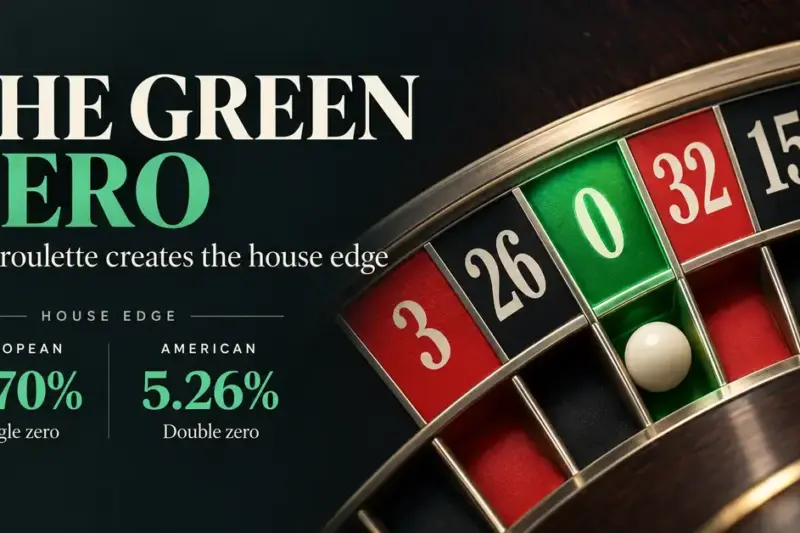
The wheel comes in two main layouts. A European wheel has 37 pockets: the numbers 1 to 36, coloured red or black, plus a single green zero (0). An American wheel has 38 pockets: the same 1 to 36, plus a green zero (0) and a green double zero (00). That extra green pocket is small to look at but large in its effect, because the zero (and double zero) belong to the house — they are the pockets on which most bets lose.
For the full rules, the wheel and table layout, and step-by-step play, see how to play roulette.
How do you play roulette?
You play roulette by placing chips on the numbers or groups of numbers you think the ball will land on, then waiting for the spin to settle. A single round follows the same short sequence every time:
- Buy chips. At a live table you exchange cash for coloured “table chips” that are unique to you, so your bets are never confused with another player’s.
- Place your bets. You put chips on the table layout before the croupier calls “no more bets.” You can back a single number, several numbers at once, or broad categories such as red, black, odd or even.
- Watch the spin. The croupier spins the wheel and releases the ball, and bets are locked once the ball is about to drop.
- The winning number is marked. The croupier places a marker (the “dolly”) on the winning number and clears every losing bet from the table.
- Winning bets are paid. Each winning bet is paid at a fixed ratio, and that ratio depends on how unlikely the bet was to win.
The betting table is split into “inside” bets on specific numbers and “outside” bets on large groups such as colours or columns, which the next section explains.
What are the main roulette bets and payouts?
Roulette bets fall into two groups: inside bets, which cover a few specific numbers and pay a lot, and outside bets, which cover large groups and pay a little. One rule sits behind every payout — the less likely a bet is to win, the more it pays. A single-number bet pays 35 to 1, while a red-or-black bet pays 1 to 1.
Inside bets
Inside bets cover one number or a small cluster of neighbouring numbers, and they carry the biggest payouts. The main ones are the straight up (one number, pays 35:1), the split (two adjoining numbers, 17:1), the street (three numbers in a row, 11:1), the corner or square (four numbers meeting at a corner, 8:1), and the six line or double street (six numbers across two rows, 5:1).
Outside bets
Outside bets cover large groups of numbers, so they win far more often but pay far less. Red or black, odd or even, and high (19–36) or low (1–18) each cover 18 numbers and pay 1:1, known as even money. Dozens (1–12, 13–24, 25–36) and columns each cover 12 numbers and pay 2:1.
Called or French bets
Called bets, also known as announced bets, are groupings based on where numbers sit on the wheel rather than on the table, and you will mostly meet them on French and European tables. Names such as voisins du zéro (neighbours of zero), tiers du cylindre (third of the wheel) and orphelins (orphans) each describe a fixed section of the wheel that you back in one announced wager.
| Bet | Numbers covered | Payout | Win chance |
|---|---|---|---|
| Straight up | 1 number | 35 : 1 | 2.70% |
| Split | 2 numbers | 17 : 1 | 5.41% |
| Street | 3 numbers | 11 : 1 | 8.11% |
| Corner (square) | 4 numbers | 8 : 1 | 10.81% |
| Six line (double street) | 6 numbers | 5 : 1 | 16.22% |
| Column | 12 numbers | 2 : 1 | 32.43% |
| Dozen | 12 numbers | 2 : 1 | 32.43% |
| Red / Black | 18 numbers | 1 : 1 | 48.65% |
| Odd / Even | 18 numbers | 1 : 1 | 48.65% |
| High / Low (1–18 / 19–36) | 18 numbers | 1 : 1 | 48.65% |
Win chance shown for a European (single-zero) wheel with 37 pockets. On an American (double-zero) wheel the same bets pay the same but win slightly less often, raising the house edge.
For a full breakdown of every bet, the exact chips-on-the-table positions and the complete payout chart, see roulette bets and payouts.
What are the odds and house edge in roulette?
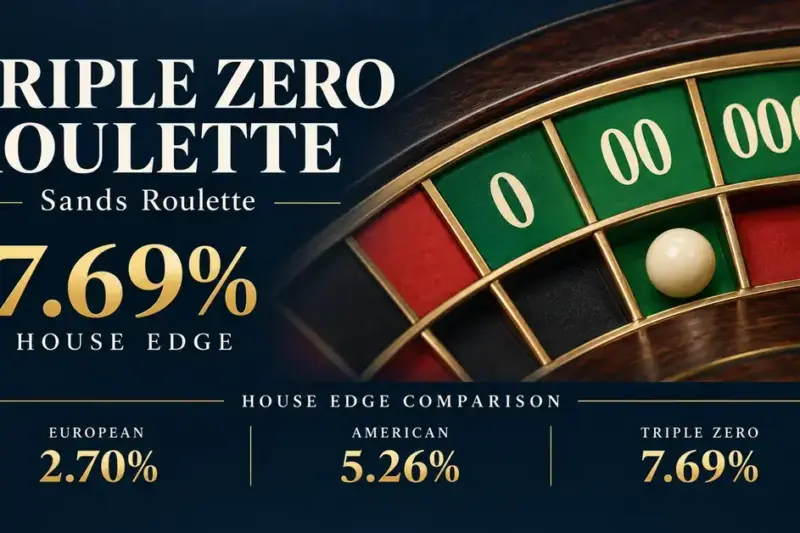
The house edge in roulette is 2.70% on a European (single-zero) wheel and 5.26% on an American (double-zero) wheel. The house edge is the share of every bet the casino keeps on average over time, and it comes from one gap: a straight-up bet has true odds of 36 to 1 against on a European wheel, but it only pays 35 to 1. That missing unit is the casino’s margin, and the same gap is built into every other bet.
The extra double-zero pocket on the American wheel does not change any payout, but it adds another way to lose, which is why the American edge of 5.26% is nearly double the European edge of 2.70%. In dollars, across CA$1,000 wagered in $10 bets, the expected loss is about $27 on a European wheel versus about $53 on an American wheel — the same game, at nearly twice the cost.
French roulette can be cheaper still. When a French table uses the la partage or en prison rule, an even-money bet such as red or black is only half-lost when the ball lands on zero, which drops the house edge on those bets to about 1.35%.
One fact matters more than any chart: the edge is identical on every spin, and no result “corrects” a previous one. For per-bet probabilities and how the edge shapes long-run results, see roulette strategy and odds.
What types of roulette are there?
The main types of roulette are European, American and French, plus the live-dealer and mini formats you will find online. The versions look alike but differ in the number of zeros and a few rules, and those small differences change your odds.
European roulette uses one zero and 37 pockets for a 2.70% house edge, and it is the most common version worldwide. American roulette uses two zeros and 38 pockets for a 5.26% house edge, and it is common in North American land-based casinos. French roulette uses a single zero but adds the la partage and en prison rules that cut the even-money edge to about 1.35%, giving it the best odds when those rules apply. Live-dealer roulette is a real wheel and croupier streamed online in real time, with rules and odds that match the wheel used, usually European. Mini and multi-wheel roulette use smaller wheels or several wheels at once, and these are novelty formats rather than better-value ones.
| Variant | Zeros | Pockets | House edge | Where you’ll find it |
|---|---|---|---|---|
| European | Single (0) | 37 | 2.70% | The most common wheel worldwide and online |
| American | Double (0 and 00) | 38 | 5.26% | Many North American land-based casinos |
| French | Single (0), with la partage / en prison | 37 | 1.35% on even-money bets | Higher-limit and European tables |
| Live dealer | Matches the wheel used (usually single) | Usually 37 | Usually 2.70% | Online, streamed in real time |
| Mini / multi-wheel | Varies | Varies | Varies (often higher) | Online novelty formats |
A lower house edge means the game keeps less of your money over time. A single-zero wheel is always better value than a double-zero wheel for the same game.
For a full comparison of every version, including exactly how la partage and en prison work, see roulette variants.
Do roulette betting systems work?
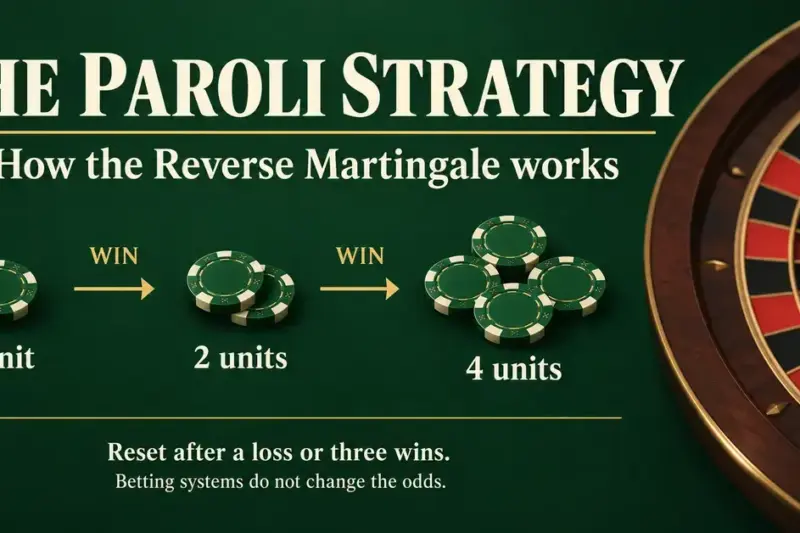
No betting system overcomes the house edge in roulette. Systems such as the Martingale (doubling your bet after every loss), the Fibonacci and the D’Alembert change the order and size of your bets, but they do not change the odds of any single spin, and every spin carries the same built-in edge. Over a long enough session, the maths always reasserts itself.
The Martingale is the clearest example of why. Doubling after each loss recovers your losses only until you reach the table’s maximum bet or run out of money, and a modest losing streak reaches both limits faster than most people expect. The system trades many small wins for the occasional catastrophic loss.
Two ideas are worth holding onto. First, each spin is independent — the wheel has no memory, so “hot” and “cold” numbers are a pattern the mind invents rather than an edge, a mistake known as the gambler’s fallacy. Second, betting systems can be a fun way to structure a session, but they are not a way to win over the long run.
Is roulette legal in Canada?
Yes — roulette is legal to play in Canada, and it is regulated province by province rather than nationally. Every province offers roulette in licensed land-based casinos, and the online picture has changed quickly in recent years. Ontario launched Canada’s first open, privately operated online market in April 2022, regulated by the Alcohol and Gaming Commission of Ontario (AGCO) with iGaming Ontario running the market. Alberta became the second province to open a competitive online market, going live on 13 July 2026 under the Alberta Gaming, Liquor and Cannabis (AGLC) regulator and the Alberta iGaming Corporation. Other provinces offer legal online play through their own government platforms, such as British Columbia’s PlayNow and Quebec’s Loto-Québec.
The legal minimum age is 19 in most provinces, and 18 in Alberta, Manitoba and Quebec. For the full provincial breakdown and how the regulated market works, see roulette in Canada.
Common roulette mistakes to avoid
The most costly roulette mistake is playing an American wheel when a European one is available, because that choice nearly doubles the house edge for exactly the same game. A few other mistakes come up again and again:
- Chasing losses with the Martingale. Doubling up after losses feels logical, but table limits and a shrinking bankroll can turn one bad streak into a large loss.
- Believing in hot and cold numbers. A number that “hasn’t come up in a while” is no more likely to appear next, because each spin is independent of the last.
- Confusing payout with probability. A 35:1 payout is not a 1-in-35 chance — the true odds are 36 to 1 against on a European wheel, and that gap is the house edge.
- Ignoring la partage and en prison. On even-money bets at a French table, these rules halve your losses on zero, yet many players never look for them.
- Playing without a budget. Roulette is entertainment with a guaranteed long-run cost, so a fixed budget set before you play is the only reliable form of bankroll management.
Avoiding these five mistakes will not make roulette a winning game — nothing does — but it keeps the cost as low as the maths allows and the session as enjoyable as intended.
Responsible gambling. Roulette is a form of entertainment with a built-in house edge, which means the game is designed for the casino to profit over time; it is not a way to make money. Only ever wager what you can afford to lose, set time and money limits before you play, and never chase losses. You must be of legal age to gamble in your province — 19 in most of Canada, and 18 in Alberta, Manitoba and Quebec. If gambling stops being fun, free and confidential help is available across Canada: contact the Responsible Gambling Council, call or text ConnexOntario at 1-866-531-2600 (text CONNEX to 247247) via connexontario.ca, or dial 9-8-8 for the Suicide Crisis Helpline if you are in crisis. See our responsible gambling page for provincial programs and self-exclusion tools.
Reference sources
- Roulette — rules, wheel layout, house edge and payouts (Wikipedia)
- iGaming Ontario — Ontario’s regulated online gaming market
- Alcohol and Gaming Commission of Ontario (AGCO)
- Government of Alberta — Alberta’s iGaming strategy and July 2026 launch
- Responsible Gambling Council (RGC)
- ConnexOntario — free, confidential gambling support
- 9-8-8 Suicide Crisis Helpline (Canada)
Frequently asked questions
Is roulette a game of skill or luck?
Roulette is a game of pure chance. Where the ball lands is random on every spin, and no skill, pattern or system changes the odds. You can choose which bets to make and how to manage your money, but you cannot influence the result of a spin.
Which roulette wheel has the best odds?
A single-zero wheel has the best odds. European roulette carries a 2.70% house edge, while American roulette carries 5.26% because of its extra double-zero pocket. French roulette can be better still, because its la partage and en prison rules cut the house edge on even-money bets to about 1.35%.
What does a straight-up bet pay in roulette?
A straight-up bet on a single number pays 35 to 1. If you bet CA$10 on one number and it wins, you receive CA$350 in winnings plus your original CA$10 stake. The true odds are 36 to 1 against on a European wheel, and that difference is where the house edge comes from.
Can you win at roulette in the long run?
No strategy wins at roulette over the long run. Every standard bet has a negative expected value, and betting systems such as the Martingale or Fibonacci rearrange your bets without removing the house edge. Short winning sessions certainly happen, but the maths favours the casino over time.
Is online roulette legal in Canada?
Yes, in a growing number of provinces. Ontario (since April 2022) and Alberta (since July 2026) run regulated markets with private operators, while other provinces offer legal online roulette through their own platforms, such as British Columbia’s PlayNow and Quebec’s Loto-Québec. The minimum age is 19 in most provinces and 18 in Alberta, Manitoba and Quebec.