
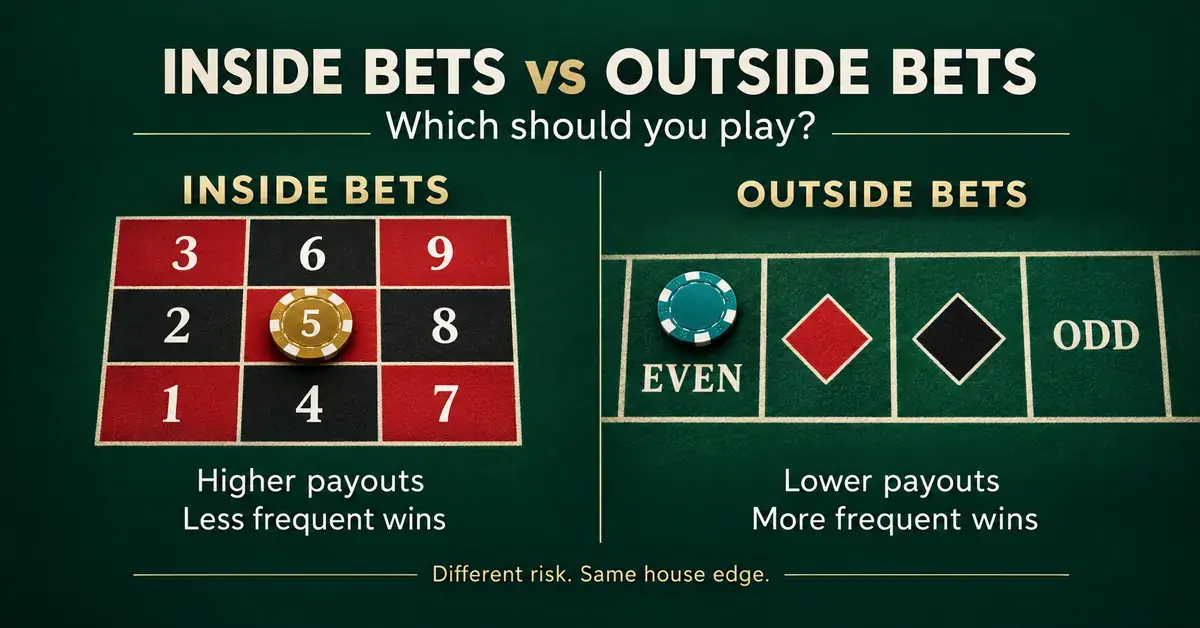
Every roulette bet falls into one of two families printed on the table: inside bets, placed on the numbered grid, and outside bets, placed in the boxes around it. The choice between them is the single biggest decision a roulette player makes, because it sets how often you win and how much you are paid when you do. This guide explains both families in plain language, lists the exact payouts and win probabilities, and helps you decide which suits your bankroll and goals — without pretending any bet can beat the house edge.
Key Points
- Inside bets sit on the numbered grid: few numbers, high payouts (up to 35:1), rare wins.
- Outside bets sit in the surrounding boxes: many numbers, small payouts (1:1 or 2:1), frequent wins.
- On a single-zero European wheel almost every bet shares the same 2.70% house edge — bet type changes variance, not long-run value.
- The American double-zero wheel raises that edge to 5.26%; choose European when you can.
- The la partage rule cuts the edge on even-money outside bets to about 1.35%, the best value on the table.
What “inside” and “outside” actually mean
On a roulette layout the numbers 1 to 36 sit in a grid, usually three columns wide, with the green 0 (and the extra 00 on American wheels) at the top. Bets placed directly on those numbers — on a single number or on the lines and corners between them — are inside bets. Bets placed in the surrounding boxes that cover large groups of numbers at once, such as red or black, are outside bets.
The core trade-off is simple: inside bets cover few numbers, so they win rarely but pay a lot; outside bets cover many numbers, so they win often but pay little. Neither option is “better” in terms of long-run value — on a standard single-zero wheel almost every bet carries the same 2.70% house edge. What changes is the shape of your results: rare big wins versus frequent small ones.
Inside bets explained
Inside bets are the high-risk, high-reward side of the table. You are targeting one number or a small cluster, so the payouts are large but the chance of hitting on any single spin is low. The main inside bets, with their standard payouts and single-zero (European, 37-number) win probabilities, are:
- Straight up — one number. Pays 35:1, win chance about 2.70% (1 in 37).
- Split — two adjoining numbers, chip on the line between them. Pays 17:1, about 5.41%.
- Street — a row of three numbers. Pays 11:1, about 8.11%.
- Corner (square) — four numbers meeting at one corner. Pays 8:1, about 10.81%.
- Six line (double street) — two adjacent rows, six numbers. Pays 5:1, about 16.22%.
A payout of 35:1 means a winning one-unit bet returns 35 units of profit plus your original stake back. Because inside bets can go many spins without landing, they suit players chasing a large payout who accept long losing streaks in between.
Outside bets explained
Outside bets cover big blocks of the wheel, so they land far more often — but the reward is modest. They are the natural choice for players who want their money to last and prefer steady action to jackpots. The main outside bets are:
- Red / Black — all 18 red or all 18 black numbers. Pays 1:1 (even money), win chance about 48.6% on a single-zero wheel.
- Odd / Even — the 18 odd or 18 even numbers. Pays 1:1, about 48.6%.
- High / Low — numbers 1–18 or 19–36. Pays 1:1, about 48.6%.
- Dozens — 1–12, 13–24 or 25–36. Pays 2:1, about 32.4%.
- Columns — one of the three vertical columns of 12 numbers. Pays 2:1, about 32.4%.
Note that the green 0 (and 00) belongs to none of these groups. That is exactly why an even-money bet wins less than half the time even though it covers 18 of 36 numbers — the zero is the house edge in physical form.
Bet Comparison
| Bet | Type | Numbers covered | Payout | Win chance (European) |
|---|---|---|---|---|
| Straight up | Inside | 1 | 35:1 | 2.70% |
| Split | Inside | 2 | 17:1 | 5.41% |
| Street | Inside | 3 | 11:1 | 8.11% |
| Corner | Inside | 4 | 8:1 | 10.81% |
| Six line | Inside | 6 | 5:1 | 16.22% |
| Dozen / Column | Outside | 12 | 2:1 | 32.4% |
| Red/Black, Odd/Even, High/Low | Outside | 18 | 1:1 | 48.6% |
The math behind the payouts
Roulette payouts are set as if the wheel had no zero. On a 37-pocket European wheel a straight-up number has a true chance of 1 in 37, but it only pays 35:1 — the two-slot gap between the true odds (36:1) and the payout is the casino’s margin. That margin works out to a 2.70% house edge on virtually every European bet, inside or outside alike.
This is the key point most “inside vs outside” debates miss: switching bet types does not change your expected loss per dollar wagered on a single-zero wheel. A straight-up bet and a red/black bet bleed the same 2.70% over time. The difference is variance — how bumpy the ride is — not the destination.
American vs European wheels change everything
The wheel you sit at matters far more than which bet you choose. The European (single-zero) wheel has 37 pockets and a 2.70% house edge. The American (double-zero) wheel adds a 00, giving 38 pockets and nearly doubling the house edge to 5.26%. Same bets, same payouts, but you lose almost twice as fast.
Two details are worth knowing:
- The five-number (basket) bet — 0, 00, 1, 2, 3 — exists only on American wheels. It pays 6:1 and carries the worst edge in the game at about 7.89%. Avoid it.
- La partage and en prison rules, offered on some European and French tables, return or “imprison” half your even-money outside bet when the ball lands on 0. That cuts the house edge on those specific bets to roughly 1.35% — the best value on the table, and available only to outside even-money bettors.
Which should you play?
There is no universally correct answer, but there is a right answer for you depending on what you want from a session:
- Choose outside bets if you want your bankroll to last, prefer frequent small wins, or are new to the game. Even-money bets on a European (ideally la-partage) wheel give the longest playing time per dollar.
- Choose inside bets if you are chasing a big payout from a small stake and accept that most spins will lose. Straight-up and split bets deliver the excitement but empty a bankroll quickly.
- Mix them — many players cover an outside bet for steadiness plus one or two inside numbers for upside. This blends the two profiles but does not lower the overall house edge.
Whatever you pick, set a budget before you start and treat any losses as the cost of entertainment. You can compare rules, variants and payout tables across the guides on Roulette Guide Canada before you sit down.
Common mistakes to avoid
- Believing a bet type improves your odds. On a single-zero wheel every bet shares the same 2.70% edge; only the variance changes.
- Chasing losses with bigger inside bets. Rare-hit bets can lose many times in a row; increasing stakes to “catch up” accelerates losses.
- Playing American wheels when European is available. The extra 00 doubles your long-run cost for no upside.
- Ignoring la partage. If you favour even-money bets, that rule is the single biggest value boost you can find.
- Confusing frequent wins with profit. Outside bets win often but pay little; the house edge is still working every spin.
Responsible gambling
Roulette is a game of chance played purely for entertainment. No bet type, betting pattern or system overcomes the built-in house edge, and outcomes cannot be predicted or influenced. The legal minimum gambling age in Canada is 19 in most provinces and 18 in Alberta, Manitoba and Quebec. Only ever wager money you can afford to lose, and set time and budget limits before you play. If gambling stops being fun, free and confidential help is available in Ontario through ConnexOntario at 1-866-531-2600 (24/7), and across the country via the provincial helplines and the Responsible Gambling Council.
Sources
- PokerNews — Roulette Bets Explained: Bet Types, Odds & Strategies
- Casino.org — Roulette Bets Explained & Reference Chart
- GamblingSites — Types of Roulette Bets, Odds and Payouts
- PokerNews — Five Number (Basket) Bet Explained
- ConnexOntario — Problem Gambling Support Services
- Responsible Gambling Council — Help for Canadians
Frequently asked questions (FAQ)
Do inside bets have better odds than outside bets?
No. Inside bets pay more but win less often, while outside bets win more often but pay less. On a single-zero European wheel both families carry the same 2.70% house edge, so neither offers better long-run value — they simply differ in how often and how much you win.
What is the safest bet in roulette?
Even-money outside bets — red/black, odd/even or high/low — win close to half the time, which makes them the lowest-variance option. On European tables that offer the la partage rule, these bets have a house edge of only about 1.35%, the best value available.
Can you bet inside and outside at the same time?
Yes. You can place chips on both an outside bet and one or more inside numbers on the same spin, as long as each bet meets the table minimum. Many players combine a steady outside bet with a small inside bet for extra upside, though this does not reduce the overall house edge.
Which roulette bet has the biggest payout?
A straight-up bet on a single number pays 35:1, the highest standard payout in roulette. It is also the least likely to win, hitting only about 2.70% of the time on a European wheel, so those large payouts come with long stretches of losing spins.
Is European or American roulette better for these bets?
European roulette is better. It has one zero and a 2.70% house edge, while American roulette adds a second zero (00) and nearly doubles the edge to 5.26%. The payouts are identical on both, so the same inside and outside bets simply cost you more on an American wheel.
