
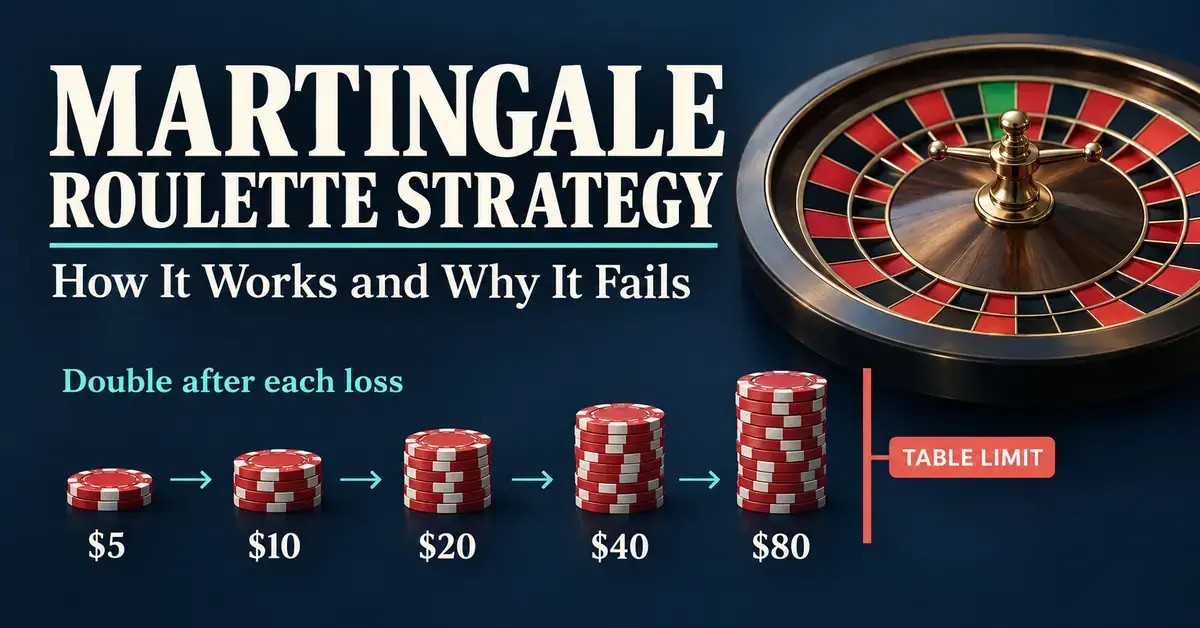
The Martingale is the most famous betting system in roulette, and the promise behind it sounds almost too good to refuse: double your bet after every loss and a single win will erase everything you lost and leave you one unit ahead. It is simple, it feels logical, and in short sessions it often appears to work. This guide explains exactly how the Martingale works, shows the math with a real progression, and lays out the concrete reasons it fails over time — so you can understand the system rather than be surprised by it.
Key Points
- What it is: a system where you double your even-money bet (Red/Black, Odd/Even, High/Low) after every loss, so one win recovers all losses plus one base unit.
- Why it looks good: it produces frequent small wins, so most short sessions end in a small profit.
- Why it fails: it never changes the house edge — 2.70% on European (single-zero) wheels and 5.26% on American (double-zero) wheels.
- Table limits: maximum bets stop you doubling after just a few losses, locking in the loss.
- Bankroll: stakes grow exponentially, so a finite bankroll runs out exactly when the system needs it most.
- Key fact: every spin is independent — past results never make a colour “due.”
What is the Martingale strategy?
The Martingale is a negative-progression betting system, meaning you increase your stake after a loss rather than after a win. It is applied to even-money bets — wagers that pay 1:1, such as Red/Black, Odd/Even, or High (19–36)/Low (1–18). These bets win close to half the time, which is what makes the system look reliable.
The idea originated in 18th-century France and was originally used for simple coin-flip style wagers. It is not unique to roulette — people apply it to blackjack, baccarat and sports betting too — but roulette’s even-money bets are its classic home. If you are new to the game, it helps to first understand how to play roulette and which bets pay even money before looking at any system built on top of them.
How the Martingale works, step by step
The rules are short enough to memorise:
- Choose an even-money bet (for example, Black) and a base stake — say $10.
- If you win, you keep the profit and start again at the base stake.
- If you lose, you double your stake on the next spin and bet on the same outcome.
- Keep doubling after every loss until you win, then return to the base stake.
Because each bet pays 1:1, a single win always returns your entire doubled stake plus an equal amount. That is enough to recover every previous loss in the sequence and finish one base unit ($10) ahead. On paper, every completed cycle nets exactly your starting bet.
The bet progression: how fast the numbers grow
The weakness of the Martingale is hidden in the doubling. Each loss does not add to your stake — it multiplies it. The table below follows a $10 base bet through a losing streak on a single-zero (European) wheel and shows how much you must risk to keep chasing that same $10 profit.
Bet Progression
| Bet # | Stake | Total wagered | Profit if this bet wins |
|---|---|---|---|
| 1 | $10 | $10 | +$10 |
| 2 | $20 | $30 | +$10 |
| 3 | $40 | $70 | +$10 |
| 4 | $80 | $150 | +$10 |
| 5 | $160 | $310 | +$10 |
| 6 | $320 | $630 | +$10 |
| 7 | $640 | $1,270 | +$10 |
| 8 | $1,280 | $2,550 | +$10 |
| 9 | $2,560 | $5,110 | +$10 |
| 10 | $5,120 | $10,230 | +$10 |
By the tenth bet in a run you are risking more than $10,000 to win $10. And this is not a rare scenario: the probability of losing seven even-money bets in a row on a European wheel is roughly 0.9% (about 1 in 106). Over a few hundred spins in an evening, a streak that long becomes likely rather than exotic.
Why the Martingale fails
The Martingale does not fail because of bad luck or poor discipline. It fails for structural reasons that no amount of skill can remove.
The house edge never changes
The house edge is the built-in mathematical advantage the casino holds on every bet. On a European (single-zero) wheel it is 2.70%; on an American (double-zero) wheel it is 5.26%. That edge comes from the green zero pockets: an even-money bet on Red wins on 18 of 37 numbers (48.6%) in European roulette, not a true 50%. The Martingale changes the size and order of your bets, but it never changes the odds of any single spin, so the long-run expected value — the average amount you lose per dollar wagered — stays negative and identical to flat betting.
Table limits cap your doubling
Every roulette table has a maximum bet, and casinos set it precisely to break progression systems. If a table runs from a $5 minimum to a $500 even-money maximum, a $10 Martingale hits the ceiling after only six or seven losses — the doubled stake of $1,280 is simply not allowed. At that point you cannot complete the recovery bet, and the entire accumulated loss is locked in with no way to win it back within the system.
Your bankroll runs out before the win arrives
Even without a table limit, your money is finite. Surviving a run of losses requires an exponentially large bankroll, and the deeper the streak, the more absurd the requirement becomes. The Martingale trades a very high chance of a tiny win for a small but real chance of a catastrophic loss — and the rare catastrophe is large enough to wipe out many prior winning sessions at once. Averaged out, the two never balance in your favour.
The wheel has no memory
The most common misconception behind the system is the belief that a long run of Black makes Red “due.” It does not. Each spin is an independent event: the wheel does not remember previous results, and the probability of Red on the next spin is always 18/37, no matter what came before. This is the gambler’s fallacy, and it is the psychological engine that keeps players doubling into a losing streak.
A worked example
Suppose you sit down with $650 and a $10 base bet on Black, at a table with a generous $1,000 maximum. You lose six spins in a row — an outcome with a probability of about 1.8% on any given six-spin sequence, so far from impossible. Your stakes were $10, $20, $40, $80, $160 and $320, for $630 lost. The recovery bet should now be $640, but you only have $20 left. The system collapses not because the math was wrong, but because reality — your bankroll — ran out exactly when the strategy demanded the most from it.
Variations and related systems
Several systems are marketed as improvements on the Martingale. It is worth knowing what they are, but none of them overcome the house edge either:
- Reverse Martingale (Paroli): you double after a win instead of a loss, aiming to ride a hot streak. This caps your losses but relies on rare long winning runs.
- D’Alembert: you raise your stake by one unit after a loss and lower it by one after a win — a gentler progression that grows more slowly but still cannot turn a negative expectation positive.
- Fibonacci: you move up the Fibonacci sequence after losses. It is less aggressive than doubling, yet it hits the same table-limit and bankroll walls in a long streak.
Some European tables also offer the La Partage or En Prison rules, which return or “imprison” half of an even-money bet when the ball lands on zero. These genuinely lower the even-money house edge from 2.70% to 1.35%, which is good value — but they reduce the cost of playing, they do not make any progression system profitable.
Who is tempted by the Martingale, and what to expect
The Martingale appeals to players who value the feeling of frequent small wins and dislike watching a bankroll drift down slowly. In the short term it delivers exactly that: most sessions end with a modest profit. The trade-off is that the occasional bad session is severe. If you choose to try it, treat it as entertainment with a strict, pre-set loss limit — not as a way to generate income. For a broader look at the game and its bets, our roulette guide covers the odds and payouts in more detail.
Ansvarsfriskrivning
This article is for informational purposes only. Roulette is a game of chance with a permanent mathematical advantage for the house, and no betting system — including the Martingale — can change the odds or guarantee a profit. Over time, the expected outcome of playing is a loss. Only ever gamble with money you can afford to lose, set limits before you play, and never chase losses. You must be of legal gambling age in your province or territory to play in Canada. If gambling is causing harm to you or someone you know, free and confidential help is available 24/7 through ConnexOntario at 1-866-531-2600, and the Responsible Gambling Council lists support services for every Canadian province.
Sources
- Wizard of Odds — Roulette basics, rules and house edge
- PokerNews — Martingale strategy for roulette: how it works and risks
- PokerNews — Differences between American and European roulette
- PlayUSA — Martingale calculator: doubling strategy and risk
- Responsible Gambling Council — Help for Canadians
- ConnexOntario — Problem gambling support services
Frequently asked questions (FAQ)
Does the Martingale strategy actually work in roulette?
It works in the sense that it produces frequent small wins, but it does not work as a way to beat roulette. It cannot change the house edge, and a single long losing streak — combined with table maximums or a limited bankroll — eventually causes a loss far larger than all the small wins combined.
How much money do I need to use the Martingale safely?
There is no truly safe amount, because the required bankroll grows exponentially with each loss. Starting at just $10, seven consecutive losses already demand a $1,280 recovery bet and total exposure of $2,550. Deep streaks can require tens of thousands of dollars, and even then a bad run can wipe you out.
Why do table limits stop the Martingale from working?
Doubling only recovers your losses if you are allowed to place the next, larger bet. Casinos cap even-money maximums specifically so that after a handful of losses the required stake exceeds the limit. Once you hit that ceiling you cannot complete the recovery, and the accumulated loss is locked in.
Is the Martingale better on European or American roulette?
European (single-zero) roulette is always the better choice because its house edge is 2.70% versus 5.26% on American (double-zero) wheels. Tables offering the La Partage or En Prison rules lower the even-money edge further to 1.35%. None of this makes the system profitable, but it reduces how much the house edge costs you.
Is the next spin more likely to be red after a long run of black?
No. Each spin is independent, and the wheel has no memory. After any sequence of results, the chance of red on the next European spin is still 18/37. Believing a colour is “due” is the gambler’s fallacy, and it is the main reason players keep doubling into a losing streak.
