
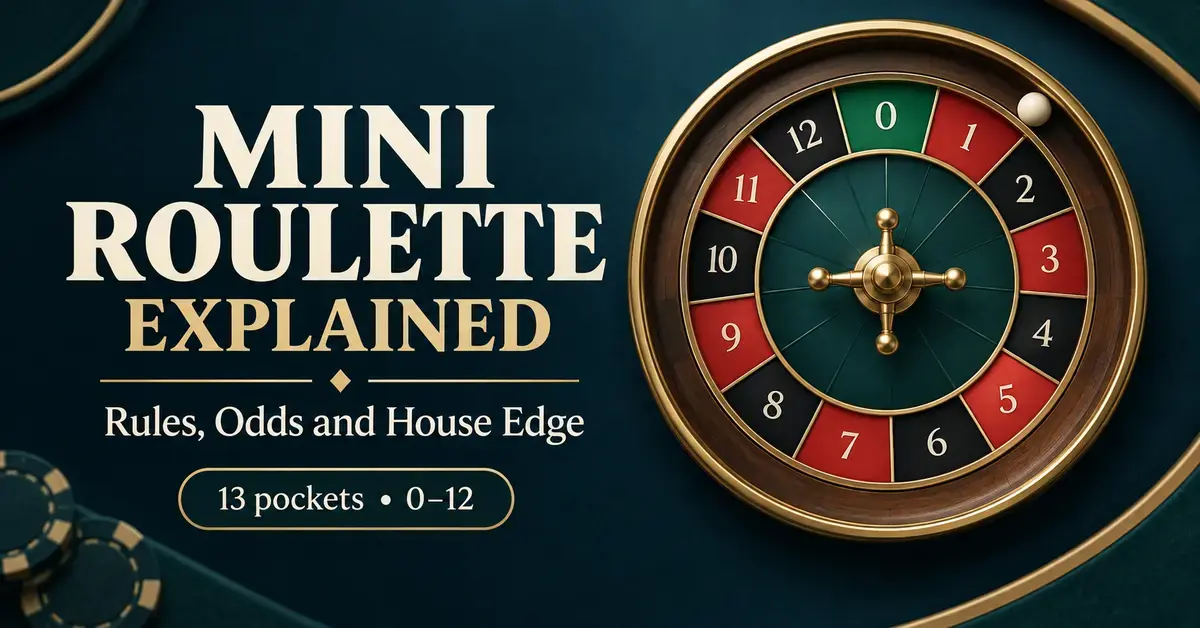
Mini roulette is a compact version of the classic casino wheel that trims the layout down to just 13 pockets — the numbers 0 through 12. It looks and plays much like standard roulette: you place chips on numbers or groups of numbers, the ball spins, and you are paid when it settles in a pocket you covered. The smaller wheel, however, quietly changes the payouts and the house edge, so it pays to understand the maths before you play. This guide explains how mini roulette works, what each bet pays, how the la partage rule softens the single zero, and how it compares with European and American roulette.
Key Points
- Wheel: 13 pockets — a single zero plus the numbers 1 to 12.
- Single-number payout: 11 to 1 (odds of hitting: 1 in 13).
- House edge: 3.85% on bets not covering the zero; 7.69% on bets that do.
- La partage: non-zero bets lose only half their stake when the ball lands on zero.
- Value check: the 3.85% edge is still higher than European roulette’s 2.70%.
- Best tip: keep your chips off the zero and any group that includes it.
What is mini roulette?
Mini roulette is a scaled-down variant of the wheel game. Instead of the 37 pockets on a European wheel or the 38 on an American wheel, a mini roulette wheel has only 13 pockets: a single green zero and the numbers 1 to 12. The betting table is shrunk to match, but the core idea is unchanged — you are betting on where a ball will land after the wheel is spun.
Because there are fewer numbers, the chance of hitting any single one is higher (1 in 13 rather than 1 in 37). That sounds appealing, but the payouts are cut to reflect it, and — as the odds section below shows — the game is not actually cheaper to play than European roulette. Mini roulette is most familiar as a software title from developer Playtech, offered as a random-number-generator (RNG) game at many online casinos alongside standard roulette.
The wheel and table layout
The wheel carries 13 numbered pockets: 0, 1, 2, 3, 4, 5, 6, 7, 8, 9, 10, 11 and 12. The zero is green; the other twelve are split evenly between red and black, six of each. On the betting table the twelve numbers are arranged in a grid of four rows of three, with the zero sitting at the top, exactly mirroring the structure of a full-size roulette table.
That grid is what makes the different bet types possible. You can back a single number, straddle the line between two numbers, cover a whole row, and so on — each option covers a different quantity of numbers and pays out accordingly.
How a round works
A round of mini roulette follows the same simple rhythm as any roulette game:
- Place your bets. Put chips on the numbers or bet areas you want to back. You can combine several bets in one round.
- Spin. In an online RNG game the wheel and ball are animated; the result is decided by the random-number generator.
- See where the ball lands. The pocket the ball settles in is the winning number.
- Collect payouts. Any bet that covers the winning number is paid at its fixed rate; everything else is lost, except where the la partage rule returns half your stake (explained below).
Bets and payouts
The payouts in mini roulette are scaled to the 13-pocket wheel, so they are much smaller than the figures you may know from standard roulette. A single-number win pays 11 to 1, not 35 to 1. The table below lists the standard bets.
| Bet | Numbers covered | Payout |
|---|---|---|
| Straight-up (single number) | 1 | 11 to 1 |
| Split (two adjacent numbers) | 2 | 5 to 1 |
| Street / row | 3 | 3 to 1 |
| Corner / square | 4 | 2 to 1 |
| Column | 4 | 2 to 1 |
| Even-money (Red/Black, Odd/Even, 1-6, 7-12) | 6 | 1 to 1 |
There are also combination bets that include the zero — for example 0-1-2 (paying 3 to 1) or 0-1-2-3 (paying 2 to 1). As the next section explains, these zero-covering bets carry a much higher house edge and are generally best avoided.
House edge and odds explained
The house edge is the average share of each bet the casino keeps over the long run — the built-in mathematical advantage that makes the game profitable for the operator. In mini roulette it comes in two very different levels:
- 3.85% — bets that do NOT cover the zero. This includes single numbers, splits, rows, corners, columns and the even-money bets. The figure is this low only because of the la partage rule described below.
- 7.69% — bets that DO cover the zero. This includes a straight bet on 0 and any combination that includes it, such as 0-1-2 or 0-1-2-3. La partage does not apply here, so the edge is double.
The maths is easy to follow with a single-number bet. You win 1 spin in 13 and are paid 11 to 1. Backing number 5 across 13 equally likely spins, you would expect one win (+11 units) and twelve losses (−12 units), a net of −1 unit over 13 spins, or about −7.69% per spin. The la partage rule turns roughly half of those zero losses back into a half-stake refund, which is what pulls the edge on non-zero bets down to 3.85%. Note that some software builds of mini roulette (for example the InBet version) omit la partage entirely, in which case every bet carries the 7.69% edge — always check the game’s rules screen.
The la partage rule and the single zero
La partage is French for “the sharing.” In mini roulette it means that if the ball lands on the green zero, any bet that does not cover the zero loses only half its stake instead of the whole amount. You get 50% of that bet back.
This rule is the reason mini roulette is playable at all from a value standpoint: without it, even a red/black bet would face the full 7.69% edge. With it, non-zero bets sit at 3.85%. The practical takeaway is simple — keep your chips off the zero and off any group that includes it, so that la partage protects you rather than being cancelled out.
Comparison
| Feature | Mini roulette | European roulette | American roulette |
|---|---|---|---|
| Pockets | 13 (0-12) | 37 (0-36) | 38 (0, 00, 1-36) |
| Number of zeros | One (0) | One (0) | Two (0, 00) |
| Straight-up payout | 11 to 1 | 35 to 1 | 35 to 1 |
| Main house edge | 3.85% (bets not covering 0) | 2.70% | 5.26% |
| Worst house edge | 7.69% (bets covering 0) | 2.70% | 7.89% (five-number bet) |
| La partage | Yes, on non-zero bets | Some tables (even-money, giving 1.35%) | Rare |
Mini roulette vs standard roulette
The comparison above makes the key point clear: mini roulette’s best-case house edge of 3.85% is still higher than European roulette’s flat 2.70%, and much higher than a European table that applies la partage to even-money bets (1.35%). The smaller wheel gives you a better chance of hitting your number, but the shorter payouts more than make up for it in the casino’s favour. Mini roulette is therefore best understood as a lighter, faster novelty format rather than a lower-cost way to play. For a broader look at the game and its main formats, see our roulette guide for Canadian players.
Where you can play mini roulette
Mini roulette is chiefly an online product. The best-known version is Playtech’s RNG title, which appears in the game libraries of casinos running Playtech software; other studios offer their own builds too. Many sites provide a free demo (play-money) mode alongside real-money play, which is a sensible way to learn the layout without risking anything. This article is informational only — roulette-guide.ca does not review or recommend operators — so always confirm that any casino you use is licensed to serve your province before you deposit.
Common mistakes to avoid
- Betting on or around the zero. Any wager covering 0 doubles the house edge to 7.69% and forfeits la partage.
- Assuming a smaller wheel means better value. The higher hit rate is offset by the reduced payouts; the edge is worse than European roulette.
- Chasing losses. No betting pattern changes the fixed house edge on each spin. Past results have no effect on the next one.
- Not checking the rules screen. Some versions drop la partage; confirm it is present before you play, since it halves the edge on most bets.
Who mini roulette suits
Mini roulette suits players who enjoy frequent, small wins and a quick, uncluttered table, and who value hitting a number more often than winning a large amount. It is also a gentle way for newcomers to learn how roulette bets and payouts work, because the grid is small and the options are few. Players focused purely on the lowest possible house edge are better served by European roulette, ideally with la partage on even-money bets.
Responsible gambling
Roulette in every form, including mini roulette, is a game of chance with a permanent house edge; no rule, system or bet selection can make it profitable over time, and outcomes cannot be predicted. Gambling should be treated as paid entertainment, never as a way to make money or recover losses. Play only with money you can afford to lose, set time and deposit limits, and take breaks. You must be of legal gambling age in your province (18 or 19 depending on where you live in Canada).
If gambling is causing you or someone you know harm, free and confidential help is available. In Ontario, ConnexOntario runs a 24/7 helpline (1-866-531-2600). Across Canada, the Responsible Gambling Council maintains a directory of provincial support services.
Sources
Frequently asked questions (FAQ)
How many numbers are on a mini roulette wheel?
A mini roulette wheel has 13 pockets: a single green zero plus the numbers 1 to 12. That is far fewer than the 37 pockets on a European wheel or the 38 on an American wheel.
What does a single-number bet pay in mini roulette?
A straight-up bet on one number pays 11 to 1. The chance of winning it is 1 in 13. The payout is smaller than the 35 to 1 offered on a full-size roulette wheel because the mini wheel has fewer numbers.
What is the house edge in mini roulette?
Bets that do not cover the zero have a house edge of about 3.85%, thanks to the la partage rule. Bets that include the zero have a house edge of 7.69%. Some versions without la partage apply 7.69% to every bet.
Does mini roulette have better odds than normal roulette?
No. Although you hit your number more often on the smaller wheel, the shorter payouts leave the best mini roulette edge (3.85%) higher than European roulette’s 2.70%. It is a faster, lighter format rather than a cheaper one.
What is the la partage rule in mini roulette?
La partage means that when the ball lands on zero, any bet that does not cover the zero loses only half its stake instead of the whole amount. This rule roughly halves the house edge on those bets, which is why you should avoid wagering on or around the zero.
