
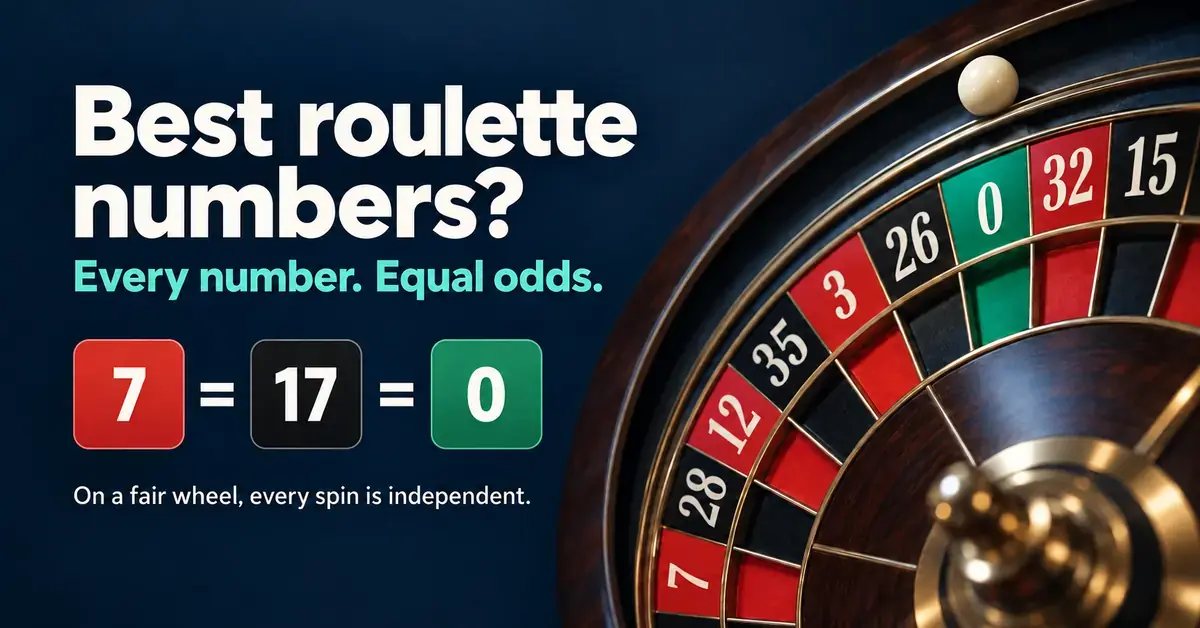
If you have ever searched for the luckiest roulette numbers, a list of digits that come up most often, or the one spot that is somehow “due” to hit, you are in very good company — it is one of the first things new players want to know. The honest, math-based answer is short: on a fair wheel, no number is any better to bet on than another. Every pocket has exactly the same chance on every single spin. This guide explains why that is true, where the myth of “best” numbers comes from, why certain numbers still get bet far more often than others, and the one historical exception that no longer applies to the games you can actually play today.
Key Points
- On a fair wheel, every number has identical odds — there is no “best” or luckiest number to bet.
- Any single number lands about 2.70% of the time on a European wheel and 2.63% on an American wheel.
- “Hot” and “cold” numbers are short-run variance, not a pattern — no number is ever “due.”
- Popular picks like 17, 7 and 0 are cultural, not mathematical; they do not win more often.
- Biased physical wheels were a real edge in the 1800s and 1990s but are not exploitable on modern or online games.
- The only choices that matter are the bet type and the wheel — pick single-zero (European/French) over American.
The short answer: no number beats another
Roulette is a game of pure chance. The ball has no memory, the wheel has no memory, and the numbered pockets are built to be identical in size and shape. When you place a chip on a single number — a bet known as a straight-up bet — you are making the same wager as the person betting on any other number, just with a different label on it. The ball is equally likely to settle in any pocket, so picking 7, 17, 23 or 32 gives you precisely the same odds and the same payout.
That is the core idea behind every claim on this page. There is no secret “best number,” no pattern that pays more, and no way to pick a digit that quietly tilts the built-in house edge in your favour. What people usually mean by “best numbers” is one of three different things — a hot streak, a lucky number, or a biased wheel — and each one has a clear, math-based explanation.
Why every number has the same odds
A standard European wheel has 37 pockets: the numbers 1 to 36 plus a single green zero. That means any one number comes up, on average, once every 37 spins — a probability of about 2.70% (1 in 37) on each spin. An American wheel adds a second green pocket, the double zero, for 38 pockets in total, so each number lands roughly 2.63% of the time (1 in 38).
Here is the part that creates the casino’s profit. A winning straight-up bet pays 35 to 1 on both wheels. That would be a perfectly fair price if there were only 36 pockets. Because the zero (and on American wheels, the double zero) adds extra pockets without raising the payout, the casino keeps a small, permanent slice: a 2.70% house edge on European roulette and a 5.26% edge on American roulette. Crucially, that edge is identical no matter which number you choose. Switching from 5 to 17 changes nothing about your chances or your payout — you can read more in our breakdown of the odds of hitting a single number.
Odds Comparison
| Wheel | Pockets | Chance any one number hits | Straight-up payout | House edge |
|---|---|---|---|---|
| European (single zero) | 37 | 2.70% (1 in 37) | 35 to 1 | 2.70% |
| American (double zero) | 38 | 2.63% (1 in 38) | 35 to 1 | 5.26% |
| French (La Partage) | 37 | 2.70% (1 in 37) | 35 to 1 | 2.70% straight-up (1.35% on even-money bets) |
“Hot” and “cold” numbers: the gambler’s fallacy
Many live and online tables display a scoreboard of recent results, often highlighting “hot” numbers that have appeared frequently and “cold” numbers that have not shown up in a while. It is tempting to read these as tips. They are not.
Over a short run of spins, chance alone produces lumps and gaps — some numbers repeat, others go missing. That is normal statistical variance, not a signal. The wheel does not “remember” that a number is overdue, and a hot number is not more likely to keep hitting. Each spin is an independent event with the same 1-in-37 (or 1-in-38) odds as the last one. Believing otherwise is the classic gambler’s fallacy: the mistaken feeling that past results change future probabilities. Online, where outcomes are produced by independently tested random number generators, the point is even clearer — see how online roulette randomness is tested.
Lucky numbers like 17, 7 and 0
If no number has an advantage, why do some get bet so much more than others? The answer is culture, not mathematics. The number 17 is famously the most popular spot on many roulette layouts. Floor managers put this down to two things: it sits almost dead-centre on the betting table, so it is easy to reach, and it has a starring role in popular culture. Sean Connery reportedly backed 17 at an Italian casino in 1963 and watched it come up three times in a row, and the former Newcastle United owner Mike Ashley is said to have won around £1.3 million on a single large straight-up bet on 17.
Other numbers draw crowds for similar reasons: 7 is widely treated as lucky, 0 attracts bets because of its green colour, and players often choose birthdays, anniversaries or jersey numbers. None of this changes the odds. It only changes which numbers people bet on — and in a game of chance, that has no bearing on which numbers actually win. A “lucky” number is a fine way to pick, as long as you understand it is for enjoyment, not an edge.
What about biased wheels?
There is one genuine historical exception to “all numbers are equal,” and it is worth understanding precisely because it is so often misremembered. A physical roulette wheel is a piece of machinery, and a worn, warped or poorly levelled wheel can favour certain pockets slightly more than others. If you could identify that bias, some numbers really would be “better.”
In 1873, an Englishman named Joseph Jagger hired clerks to log thousands of spins at Monte Carlo, found a wheel whose frets had worn unevenly, and won a large fortune before the casino rotated its equipment and shut the loophole. In the 1990s, Gonzalo Garcia-Pelayo used a computer to analyse recorded spins and exploit subtle imperfections at a Madrid casino. Both are real stories — but both relied on a measurable mechanical flaw, enormous data collection, and the casino not noticing.
Today this is essentially impossible to profit from. Modern wheels are precision-engineered, regularly inspected, rotated and monitored for exactly this kind of drift, and the number sequence is deliberately arranged to spread similar values around the rim (see the roulette wheel number sequence). Online roulette has no physical wheel to wear out at all. For any game you can realistically sit down at, there is no detectable bias to exploit.
The bet type matters more than the number
Since the specific number you choose is irrelevant, the only decision with a real effect is what kind of bet you make and which wheel you play. These change how your money behaves, not the house edge on a straight-up bet:
- Straight-up (one number): rare wins, big 35-to-1 payout, high swings.
- Covering more numbers (splits, corners, columns, red/black): more frequent but smaller wins and gentler swings — the trade-off between risk and reward, not a better edge.
- Choose the single-zero wheel: European or French roulette (2.70%) is always a better deal than American (5.26%), and French rules can cut the edge on even-money bets to as little as 1.35%.
- Avoid the five-number bet: the 0-00-1-2-3 wager found only on American wheels pays 6 to 1 and carries a 7.89% edge — the single worst bet on the table.
For a complete picture of how each wager behaves, see our guide to roulette strategy and odds.
How to choose numbers if you just want to play
None of this means you cannot enjoy picking numbers — it only means you should pick them for fun, not in the belief that you have found an advantage. A few sensible habits:
- Pick numbers you like — birthdays, lucky digits, patterns on the layout. One choice is as good as any other.
- Decide how much you are willing to lose before you start, and treat it as the price of entertainment.
- Ignore “hot number” boards, number-prediction systems and anything sold as a way to beat the wheel. If a method truly worked, casinos would not offer the game.
- Prefer single-zero (European or French) tables whenever you have the choice.
Responsible Gambling
Roulette is a game of chance with a permanent house edge; no number, system or strategy changes the odds in your favour, and this article is information only, not betting advice. Play only with money you can afford to lose and set limits before you start. The legal gambling age in Canada is 18 or 19 depending on your province. If gambling is causing harm for you or someone you know, free, confidential help is available 24/7 from ConnexOntario (1-866-531-2600) and from the Responsible Gambling Council.
Sources
- PokerNews — Roulette Numbers Guide: Strategies & Odds
- Snopes — The Man Who Broke the Bank at Monte Carlo (Joseph Jagger)
- Casino.org — Gonzalo Garcia-Pelayo and biased-wheel play
- DeucesCracked — Roulette odds, house edge and bet types
- Pokerfuse — Roulette guide (five-number bet and house edge)
- ConnexOntario — gambling, mental health and substance use support
- Responsible Gambling Council
Frequently asked questions
What are the best numbers to bet in roulette?
There are none. On a fair wheel every number has the same chance of coming up — about 2.70% per spin on a European wheel and 2.63% on an American wheel — and every straight-up bet pays the same 35 to 1. No number is luckier or more likely to win than another.
Which number hits most often in roulette?
Over the long run, all numbers hit at the same rate. In any short session some numbers will appear more than others purely by chance, but that is random variance, not a pattern you can predict or profit from. A number that has been “hot” is not more likely to keep hitting.
Why do so many people bet on 17?
Number 17 sits near the centre of the betting layout, making it easy to reach, and it is famous from high-profile wins and film scenes. That popularity is cultural — it affects how many people bet on 17, not how often 17 actually wins.
Is a number ever “due” to come up?
No. Each spin is independent, so a number that has not appeared in a long time is no more likely to land on the next spin than any other. Believing a number is “due” is the gambler’s fallacy.
Can you beat roulette by picking the right numbers?
Not on any modern game. Historically, a few players exploited physically biased wheels, but today’s wheels are precision-built and monitored, and online games use tested random number generators. No system of number selection overcomes the house edge.
