
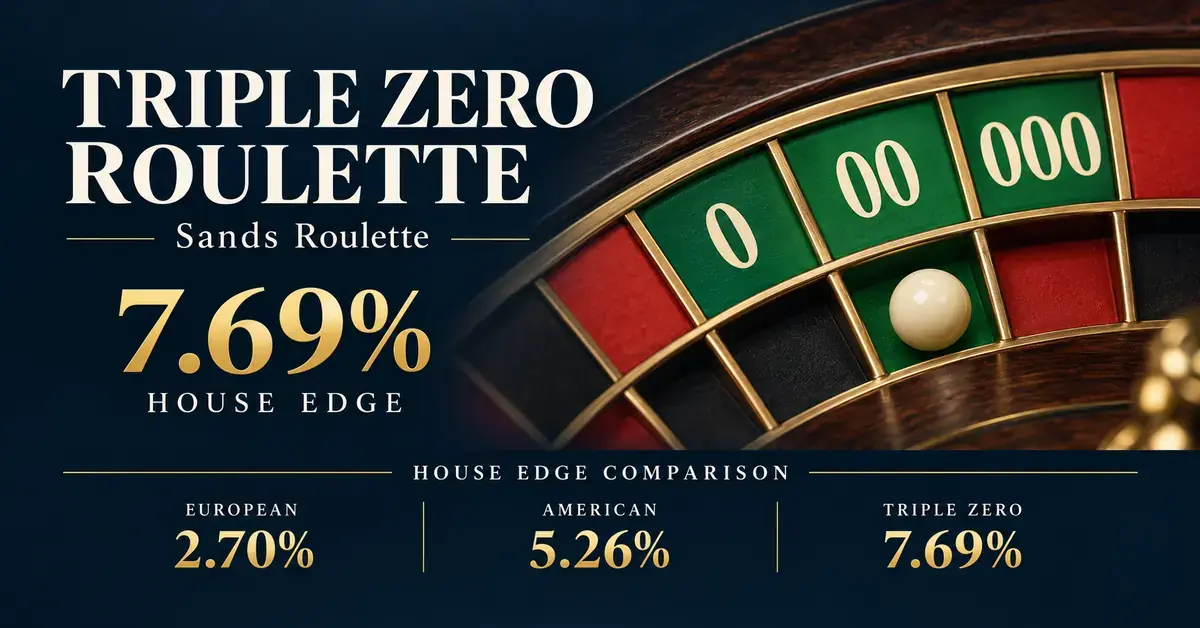
Triple zero roulette, sold on the Las Vegas Strip under the brand name Sands Roulette, is a version of the game that adds a third green pocket to the wheel. That one extra pocket may look harmless, but it pushes the casino’s built-in advantage to 7.69% — nearly three times the edge of a single-zero European wheel. This guide explains how the game works, what the bets pay, and the simple math behind why it is the most expensive form of roulette you are likely to find.
Key Facts
- Also known as: Sands Roulette, 000 roulette
- Pockets on the wheel: 39 (numbers 1–36 plus 0, 00 and 000)
- House edge: 7.69% on essentially every bet
- Straight-up payout: 35 to 1 (same as other wheels)
- Even-money win chance: 46.15% (18 of 39 pockets)
- First appeared: 2016, The Venetian, Las Vegas
- Compared with: European 2.70% · American 5.26% · Triple zero 7.69%
What is triple zero roulette?
A standard American roulette wheel has 38 pockets: the numbers 1 to 36 plus two green zeros, 0 and 00. Triple zero roulette keeps all of those and adds one more green pocket, giving the wheel 39 pockets in total. The three green pockets are 0, 00 and the new 000 (“triple zero”).
Everything else about the game is familiar. The dealer spins the wheel, drops the ball, and you bet on where it will land — a single number, a colour, a column, odd or even, and so on. The betting layout and the rules of play are identical to the American game. The only change is that extra green pocket, and that single change is what makes the game so much worse for the player.
Where the “Sands Roulette” name comes from
The triple zero wheel first appeared in Las Vegas in 2016 at The Venetian, a property then owned by Las Vegas Sands. The casino branded it Sands Roulette, and on the physical felt the third zero is usually displayed not as “000” but as an “S” inside the Sands logo. Because the branding is subtle, less experienced players sometimes sit down without realising they are on a 39-pocket wheel rather than a standard 38-pocket one.
The format has since spread to other casinos and to a number of online roulette studios, where it may be labelled “triple zero”, “000 roulette” or “Sands Roulette”. Whatever the name on the screen, the defining feature is always the same: three green pockets instead of two.
How the triple zero wheel is laid out
The wheel carries 39 numbered pockets:
- The numbers 1 through 36, coloured red and black as usual (18 of each).
- Three green pockets: 0, 00 and 000.
On the betting layout the three zeros sit at the top of the number grid, above the three columns of 1–36, exactly where 0 and 00 sit on an American table. The green pockets belong to no colour, no column and no dozen, which is the key to how the house makes its money — the same principle explained in our guide to the green zero and the house edge.
Triple zero roulette rules and payouts
The bets and the payouts are the standard roulette set. Nothing about what a winning bet pays changes on a triple zero wheel — only your chance of winning it does. The most common bets are:
- Straight up (one number) — pays 35 to 1.
- Split (two numbers) — pays 17 to 1.
- Street (three numbers) — pays 11 to 1.
- Corner (four numbers) — pays 8 to 1.
- Column or dozen (12 numbers) — pays 2 to 1.
- Even-money bets — red/black, odd/even, high/low — pay 1 to 1.
For a full breakdown of every wager and what it returns, see our roulette bets and payouts guide. The important point on a triple zero wheel is that these payouts are set as if there were fewer pockets than there actually are — and that gap is the house edge.
Why the house edge is so high (7.69%)
The house edge is the share of every bet the casino expects to keep over the long run. On roulette it comes entirely from the green zeros, because they are not covered by the colour, column or even-money bets, yet the payouts are calculated as if they did not exist.
Take a straight-up bet on a single number. A fair game would pay 38 to 1, because there are 38 other pockets the ball could land in. The casino pays only 35 to 1. On a wheel with 39 pockets the long-run result on a $1 straight-up bet looks like this:
- You win 1 time in 39 and collect 35 units: 35 ÷ 39.
- You lose 38 times in 39 and give up 1 unit each time: 38 ÷ 39.
- Net expectation: (35 − 38) ÷ 39 = −3 ÷ 39 = −7.69%.
That 7.69% applies to essentially every bet on the wheel, not just straight-up wagers, because all of them leave the three green pockets as pure profit for the house. On an even-money bet such as red or black, for example, 18 pockets win and 21 lose (18 of the other colour plus the three zeros), so you win just 18 ÷ 39 = 46.15% of the time while being paid as though it were an even contest.
Compare that with the single-number math on a European wheel in our explainer on the odds of hitting a single number, and you can see how each added zero drags the same 35:1 payout further away from fair.
How triple zero compares to other wheels
The best way to understand triple zero roulette is to line it up against the wheels you are more likely to know. Every extra green pocket keeps the payouts the same while adding one more way to lose, so the edge climbs steadily.
Variant Comparison
| Wheel | Pockets | Green zeros | House edge |
|---|---|---|---|
| European (single zero) | 37 | 0 | 2.70% |
| French (single zero, la partage) | 37 | 0 | 1.35% on even-money bets |
| American (double zero) | 38 | 0, 00 | 5.26% |
| Triple zero (Sands) | 39 | 0, 00, 000 | 7.69% |
| Quadruple zero (rare) | 40 | 0, 00, 000, 0000 | 10% |
The jump from a double-zero wheel to a triple-zero wheel costs you roughly an extra $2.43 per $100 wagered over the long run (7.69% versus 5.26%). The contrast with a European wheel is starker still: at 2.70%, the single-zero game keeps less than half as much as Sands Roulette. If you want the full side-by-side on the two mainstream wheels, see European vs American roulette, and for the whole family of games our roulette variants hub covers each one in turn.
Casinos have even been reported to trial a quadruple-zero wheel with 40 pockets, which would raise the edge to a full 10%. It remains a rarity, but it shows the direction the number-of-zeros arms race can travel.
Where you can play it — and the picture in Canada
Triple zero roulette started as a land-based Las Vegas product and is still mostly found on the Strip and at some US online casinos. In Canada it is far less common. Licensed Canadian online casinos and provincial sites tend to lead with European (single-zero) and American wheels, and some offer French roulette, which carries the lowest edge of all. Whether you are playing in a provincial casino or online, it is worth confirming which wheel you are on before you sit down — for the legal background, see our overview of roulette in Canada.
If your goal is to make a modest bankroll last, the single most effective choice you can make is the wheel itself. A European or, better still, a French roulette table with the la partage rule returns far more of your money over time than a triple zero wheel. No betting system changes that: the edge is fixed in the pockets, not in how you stake.
Common mistakes and who the game suits
A few things trip up players at a Sands Roulette table:
- Not noticing the third zero. Because it is marked with an “S” rather than “000”, the wheel can look like an ordinary American table at a glance. Count the green pockets before you bet.
- Assuming the payouts are better. They are not. The payouts are identical to other wheels; only your odds are worse.
- Chasing losses with a system. Progression systems such as the Martingale cannot overcome a 7.69% edge; they simply move the same expected loss around and can empty a bankroll quickly.
So who is it for? Realistically, triple zero roulette suits a casual player who finds the specific table or online studio fun and is treating the cost purely as entertainment. For anyone focused on stretching their money or getting the fairest shot, it is the wrong wheel — a single-zero game is strictly better in every way that matters.
Responsible gambling
Roulette is a game of chance with a fixed house edge, and triple zero roulette carries one of the highest edges you will encounter. No bet, pattern or betting system can turn that edge in your favour, so treat any money wagered as the cost of entertainment, never as a way to make income. In Canada the legal age to gamble is 19 in most provinces and 18 in Alberta, Manitoba and Quebec. Set a time and money limit before you play and stop when you reach it. If gambling is causing you or someone you know harm, free, confidential help is available from the Responsible Gambling Council and from provincial problem-gambling helplines such as ConnexOntario (1-866-531-2600). This article is for information only and is not betting advice.
Sources
Frequently asked questions
How many pockets does a triple zero roulette wheel have?
It has 39 pockets: the numbers 1 to 36, plus three green zeros marked 0, 00 and 000. That is one more pocket than a standard American wheel and two more than a European wheel.
What is the house edge on triple zero roulette?
The house edge is about 7.69%, meaning the casino expects to keep roughly $7.69 of every $100 wagered over the long run. That is higher than American roulette (5.26%) and European roulette (2.70%), and it applies to almost every bet on the wheel.
Why is it called Sands Roulette?
The game debuted in 2016 at The Venetian in Las Vegas, then owned by Las Vegas Sands, which branded it Sands Roulette. On the felt the third zero is usually shown as an “S” in the Sands logo rather than written out as “000”.
Do the payouts change on a triple zero wheel?
No. A straight-up number still pays 35 to 1, even-money bets still pay 1 to 1, and so on. The payouts are the same as on other wheels — but because there is an extra pocket, your chance of winning each bet is lower, which is where the higher house edge comes from.
Is triple zero roulette worth playing?
Mathematically it is the worst common roulette bet, so if you have a choice, a single-zero European or French wheel is a better option because it returns more of your money over time. Triple zero roulette only makes sense as casual entertainment where you accept the higher cost.
