
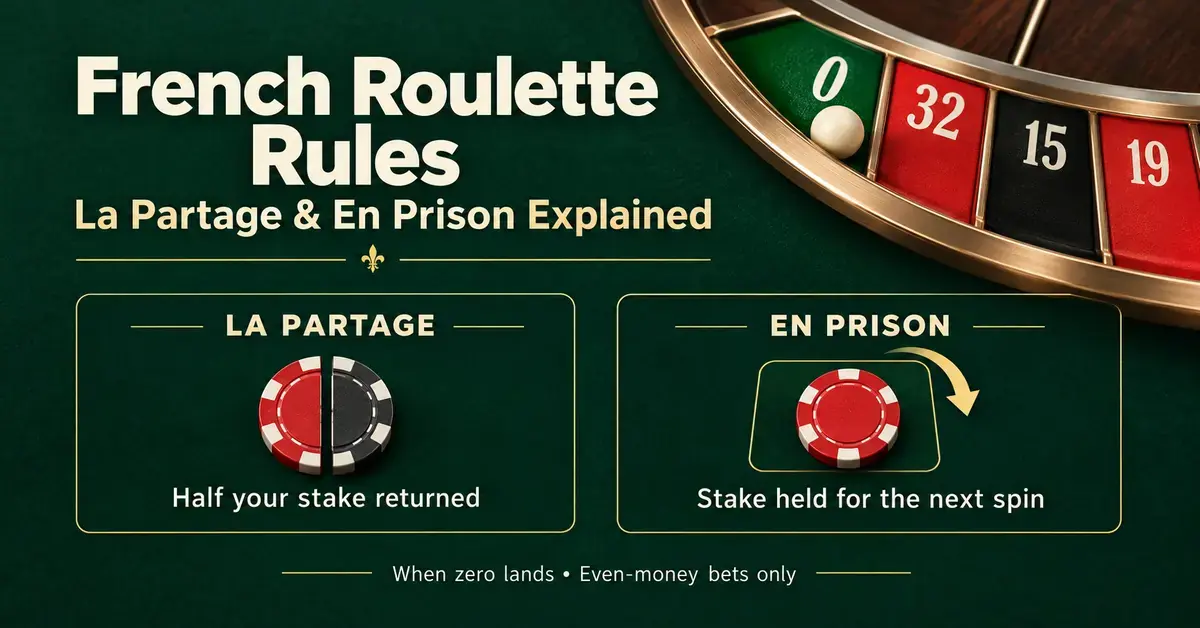
French roulette is often described as the most player-friendly version of the game, and the reason comes down to two rules with French names: La Partage and En Prison. Both hand part of your stake back when the ball lands on zero, which cuts the house edge on even-money bets roughly in half. This guide explains precisely how each rule works, when it applies, how the French table and bet names are laid out, and how French roulette compares with the European and American wheels you may already know.
Key Facts
- Wheel: single zero, 37 pockets numbered 0–36
- Standard house edge: about 2.70%
- Even-money edge with La Partage / En Prison: about 1.35%
- Special rules: La Partage (half stake returned) and En Prison (stake held for one more spin)
- Bets affected by the rules: even-money outside bets only (Rouge/Noir, Pair/Impair, Manque/Passe)
- Reputation: the most player-friendly mainstream roulette variant
What is French roulette?
French roulette is the original European form of the game. It uses a wheel with 37 pockets numbered 0 to 36 — the same wheel used in European roulette. The differences are on the table, not the wheel: French roulette uses French labels for the outside bets, splits those bets on both sides of the layout, and, most importantly, applies the La Partage or En Prison rule to even-money wagers. If you want a broader starting point before diving into the details, our main roulette guide covers the basics of the game.
The single-zero wheel and the house edge
A roulette wheel’s house edge is the built-in mathematical advantage the casino holds on every bet. It comes from the green zero pockets, which are not covered by the standard red/black or number bets.
French roulette has just one green pocket — the zero — among its 37 numbers. That single zero gives a house edge of 1 ÷ 37, or about 2.70%, on most bets. By comparison, American roulette adds a second green pocket (a double zero, 00) for 38 pockets and a much steeper 5.26% edge. On its own, then, French roulette already matches European roulette for fairness. The La Partage and En Prison rules push it further, lowering the edge on even-money bets to about 1.35% — the lowest house edge you will find in mainstream roulette.
The La Partage rule explained
“La partage” means “the division” or “the sharing.” Under this rule, if you place an even-money bet — a wager that pays 1:1, such as red/black, odd/even or high/low — and the ball lands on zero, you lose only half of your stake. The other half is returned to you immediately.
Here is a simple example. You bet C$10 on red and the ball lands on 0. Without La Partage you would lose the full C$10. With La Partage, C$5 is returned and you lose only C$5. The bet is settled on that spin — there is no waiting for another result.
Two points are worth keeping in mind:
- La Partage applies only to even-money bets. It does not apply to inside bets such as single numbers, splits or corners; those still carry the full 2.70% edge.
- Because you lose only half your even-money stake when zero appears, the effective house edge on those bets drops from 2.70% to about 1.35%.
The En Prison rule explained
En Prison (“in prison”) is the alternative some casinos offer instead of La Partage. Again it applies only to even-money bets. When the ball lands on zero, your stake is not lost right away — instead the croupier places a marker on it and it is “imprisoned” for the next spin. What happens next depends on that following result:
- The bet wins: your original stake is released and returned to you, but you collect no winnings on it.
- The bet loses: the imprisoned stake is forfeited.
- Zero appears again: handling varies by casino. The stake may remain imprisoned, or the house may return half under La Partage-style rules. It is worth checking the specific table’s rules before you play.
Over the long run, En Prison produces the same roughly 1.35% house edge on even-money bets as La Partage — the two rules are mathematically similar. The practical difference is timing: La Partage settles on the same spin, while En Prison ties up your stake for an extra spin before it is resolved.
La Partage vs En Prison: which is better?
For the returns you can expect over many spins, there is little to separate them; both give even-money bets an edge of about 1.35%. La Partage is simpler and quicker because it resolves at once, and you keep control of the returned half immediately. En Prison gives your full stake a second chance to survive rather than guaranteeing half back. Some casinos offering En Prison also let you “surrender” instead — taking half your stake back rather than sending it to prison — which is effectively La Partage. When both are available, most players prefer the certainty and speed of La Partage.
The French table layout and bet names
The French table uses the same bets as European roulette, but the outside wagers carry French labels and are printed on both sides of the number grid. Beginners sometimes find the French words confusing at first, so here is what they mean.
Even-money (outside) bets
These are the only bets to which La Partage and En Prison apply:
- Rouge / Noir — red or black.
- Pair / Impair — even or odd.
- Manque / Passe — low (1 to 18) or high (19 to 36). “Manque” covers the low numbers and “Passe” covers the high numbers.
Inside bets and payouts
Inside bets are placed directly on the numbers and pay more because they are harder to hit. On a single-zero wheel the standard payouts are:
- Straight up (one number): 35:1
- Split (two numbers): 17:1
- Street (three numbers): 11:1
- Corner (four numbers): 8:1
- Six line (six numbers): 5:1
- Column or dozen (twelve numbers): 2:1
- Even-money bets (eighteen numbers): 1:1
Announced (call) bets
French roulette also features announced bets — groups of numbers based on their position on the wheel rather than the table grid, often placed on an oval “racetrack” section. The main ones are:
- Voisins du Zéro (“neighbours of zero”): 17 numbers around the zero, covered with 9 chips.
- Tiers du Cylindre (“third of the wheel”): the 12 numbers opposite zero, covered with 6 chips as split bets.
- Orphelins (“orphans”): the 8 numbers not included in the two groups above, covered with 5 chips.
These call bets do not change the odds; they are simply a traditional way to cover sections of the wheel with a single announcement.
French vs European vs American roulette
All three share the same core game, but the wheel and rules differ in ways that directly affect your expected returns. The table below sums up the key numbers.
Comparison
| Variant | Pockets | Green pockets | Standard house edge | Even-money edge with special rules |
|---|---|---|---|---|
| French | 37 (0–36) | One (0) | 2.70% | ~1.35% (La Partage / En Prison) |
| European | 37 (0–36) | One (0) | 2.70% | 2.70% (unless the table offers La Partage) |
| American | 38 (0, 00, 1–36) | Two (0 and 00) | 5.26% | 5.26% (no special rules) |
How to start playing French roulette
Getting started is straightforward once you understand the layout:
- Confirm the game is genuinely French roulette and that La Partage or En Prison is active on even-money bets — the rules are usually printed on the table or in the game information panel.
- Set a budget before you play and treat it as entertainment spending, not an investment.
- If low house edge is your priority, focus on the even-money bets, since only those benefit from La Partage and En Prison.
- Learn the French labels (Rouge/Noir, Pair/Impair, Manque/Passe) so you can follow the table and the croupier’s calls.
Common mistakes to avoid
- Assuming the special rules apply to every bet. La Partage and En Prison only reduce the edge on even-money bets; inside bets keep the full 2.70% edge.
- Believing the rules make roulette profitable. A 1.35% edge is low, but it is still an edge in the casino’s favour over time.
- Confusing French with European roulette. They use the same wheel, but a European table without La Partage or En Prison does not give you the reduced even-money edge.
- Chasing losses with betting systems. No staking pattern changes the underlying odds of each independent spin.
Who French roulette suits
French roulette is best suited to players who favour the even-money bets — red/black, odd/even, high/low — because that is where the La Partage and En Prison rules deliver their lower 1.35% edge. It is also a sensible choice for beginners who want the fairest mainstream version of the game and a simple set of bets to start with. Players who mainly chase big inside-bet payouts gain no special advantage from the French rules, since those bets are unaffected.
Disclaimer
Roulette is a game of chance with a built-in house edge; no rule, bet or system removes it, and over time the casino keeps a percentage of all wagers. La Partage and En Prison lower the edge on even-money bets but do not make roulette profitable. This article is informational only and is not gambling advice. You must be of legal gambling age in your province or territory (18 or 19, depending on where you live). If gambling is affecting you or someone you know, free and confidential help is available in Canada through ConnexOntario (1-866-531-2600, or text CONNEX to 247247) and the Responsible Gambling Council, which offer support and self-exclusion information across the country.
Sources
Frequently Asked Questions (FAQ)
What is the difference between La Partage and En Prison?
Both apply to even-money bets when the ball lands on zero. La Partage returns half of your stake immediately and settles the bet on that spin. En Prison instead holds your full stake for the next spin: if it wins you get your stake back with no winnings, and if it loses the stake is forfeited. Over the long run both produce a similar house edge of about 1.35%.
Does French roulette have a lower house edge than European roulette?
Both use a single-zero wheel with a base house edge of about 2.70%. French roulette lowers that to roughly 1.35% on even-money bets thanks to La Partage or En Prison. A European table without those rules does not offer the reduced edge, so on even-money bets French roulette is the more player-friendly option.
Do La Partage and En Prison apply to all bets?
No. They apply only to even-money bets — red/black (Rouge/Noir), odd/even (Pair/Impair) and low/high (Manque/Passe). Inside bets such as single numbers, splits and corners are not affected and keep the full 2.70% house edge.
What happens if zero comes up twice in a row under En Prison?
Handling varies from casino to casino. The imprisoned stake may stay in prison for another spin, or the house may apply a La Partage-style split and return half. Because there is no single universal rule, it is worth checking the specific table’s terms before you play.
What are Voisins du Zéro, Tiers du Cylindre and Orphelins?
They are announced (call) bets that cover groups of numbers based on their position on the wheel. Voisins du Zéro covers 17 numbers around the zero, Tiers du Cylindre covers the 12 numbers opposite zero, and Orphelins covers the remaining 8 numbers. They are a traditional way to bet on a section of the wheel and do not change the odds.
