
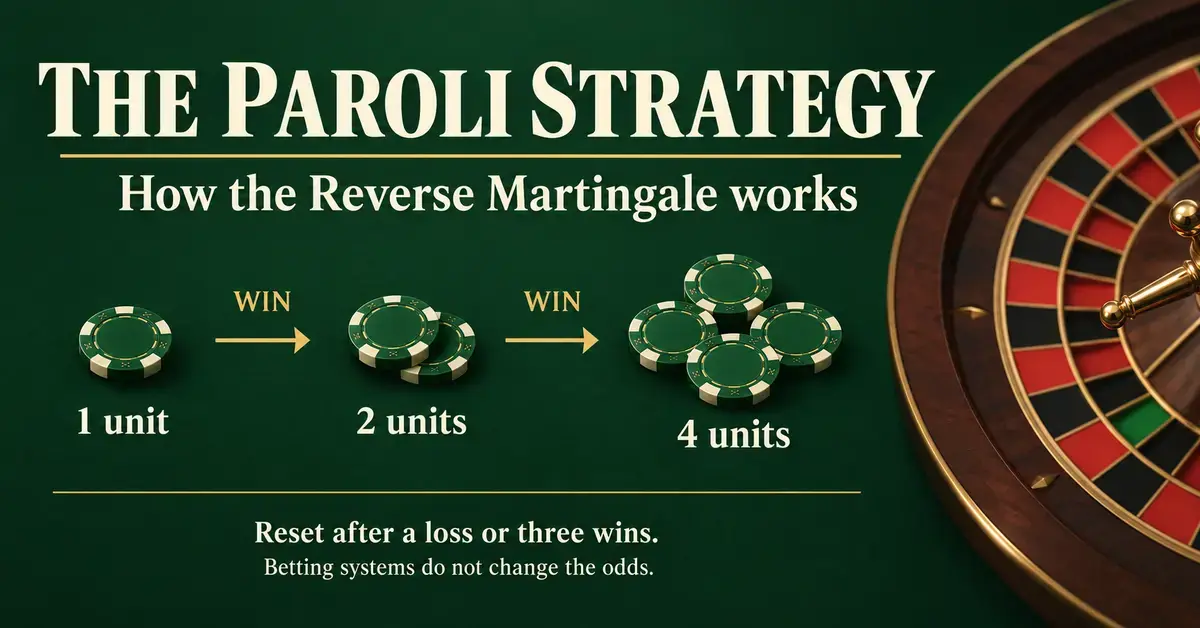
The Paroli is one of the simplest roulette betting systems you can learn, and it works in the opposite direction to the famous Martingale. Instead of chasing losses by betting more after you lose, the Paroli asks you to bet more after you win. Because of this mirror-image logic, it is often called the Reverse Martingale. This guide explains exactly how the Paroli works, walks through a real example with numbers, looks at where the name comes from, and — most importantly — is honest about what it can and cannot do to the odds.
What is the Paroli strategy?
The Paroli is a positive progression betting system. A “progression” simply means a rule for changing your bet size from one spin to the next. In a positive progression you raise your stake after a win; in a negative progression, like the Martingale system, you raise it after a loss.
The idea behind the Paroli is to ride short winning streaks using money the table has just paid you, while keeping your own stake small when the wheel is cold. It is designed for even-money bets — red or black, odd or even, and 1–18 or 19–36 — because those pay 1 to 1, which the doubling pattern relies on.
Key Points
- The Paroli is a positive progression: you double your bet after a win, not after a loss.
- It is also called the Reverse Martingale because it mirrors the Martingale system.
- Used on even-money bets; you reset after three straight wins or any loss.
- A full three-win cycle banks +7 base units; any loss costs just 1 base unit.
- It manages your staking but does not change the house edge (2.70% European / 5.26% American).
Where the name comes from
The word “paroli” is old. It came into English through French from the Italian (Neapolitan) paroli, and it appears in the 18th-century card game faro, where it described leaving your winnings on the table as part of your next bet — a term recorded as far back as 1701. The same root gives us the modern gambling word parlay, which still means rolling a stake plus its winnings into a fresh wager. So the Paroli is, at heart, a structured way of parlaying: you let your winnings ride, but only for a set number of spins.
How the Paroli strategy works
The method has only a few rules, which is a big part of its appeal:
- Pick a base unit. This is your starting bet — say $10. Keep it small relative to your bankroll.
- Bet it on an even-money option. For example, red.
- After a win, double your bet. You let the stake and its winnings ride onto the next spin.
- After a second win, double again.
- Stop after the third win or after any loss, and reset to your base unit.
The three-win cap
The Paroli is usually capped at three consecutive wins. Once you hit that third win, you bank everything and start the next cycle at your base bet. The cap exists because winning streaks do not last forever, and the whole point of the system is to collect a modest profit before the inevitable loss arrives. Letting the bet ride indefinitely would eventually hand the entire stack back to the table.
A worked example
Suppose your base unit is $10 and you are betting on black:
- Spin 1: Bet $10 and win. You now have $20 on the table (your $10 plus $10 in winnings).
- Spin 2: Let it ride — bet $20 and win. You now have $40.
- Spin 3: Bet $40 and win. You now have $80. You have hit the three-win cap, so you take it all and reset to $10.
That completed cycle leaves you with a $70 profit — seven times your base unit. Here is the clever part: because every increase was funded by the table’s money, a loss at any point costs you only your original $10 for the whole cycle. Lose on spin one and you are down $10. Win once then lose and you give back the $10 you won plus your stake — still a net loss of just $10. In other words, a Paroli cycle ends in one of two ways: +7 units if you win three in a row, or −1 unit on any loss.
At a Glance
| Also known as | Reverse Martingale, Parlay system |
|---|---|
| Type | Positive progression betting system |
| Best used on | Even-money bets (red/black, odd/even, high/low) |
| You increase after | Each win |
| You reset after | Three consecutive wins, or any loss |
| Full winning cycle | +7 base units |
| Maximum loss per cycle | 1 base unit |
| Effect on house edge | None (2.70% European / 5.26% American) |
Paroli vs the Martingale
The Paroli and the Martingale are often taught together because they are exact opposites. The Martingale doubles after losses and resets after a win, which means a single long losing streak can balloon your stake to enormous sizes and run straight into the table limit. The Paroli doubles after wins, so your stake only ever grows using house money and a cold run bleeds your bankroll slowly rather than exponentially. The table below sums up the differences, with flat betting (always wagering the same amount) added for context.
| Feature | Paroli (Reverse Martingale) | Martingale | Flat betting |
|---|---|---|---|
| Progression type | Positive (raise after wins) | Negative (raise after losses) | None |
| You increase after a… | Win | Loss | — |
| Reset trigger | Three wins, or any loss | A win | — |
| Worst case per cycle | Lose 1 base unit | Stake grows until it hits the table limit | Lose 1 unit per spin |
| Chases losses? | No | Yes | No |
| Changes the house edge? | No | No | No |
Does the Paroli beat the house edge?
No — and this is the single most important thing to understand. No betting progression can change roulette’s built-in house edge, which comes from the green zero (or zeros) paying out at less than true odds. On a single-zero European wheel the edge is 2.70%, and on a double-zero American wheel it is 5.26%. Every even-money spin carries that same disadvantage no matter how you size your bets.
A progression like the Paroli changes the shape of your results — it clusters your wins and losses differently — but it does not change the long-run expected value. Each spin is independent: the wheel has no memory of your last three results, so believing a streak is “due” to continue (or to end) is the classic gambler’s fallacy. The Paroli is best thought of as a staking discipline and a bit of structure for a session, not a way to get an edge. For the bigger picture on why no system beats the wheel, see our guide to roulette strategy and odds.
Advantages and drawbacks
Weighed honestly, the Paroli has clear pros and cons:
- Low and predictable downside. A losing cycle costs just one base unit, so you are never chasing losses or risking your whole bankroll on one streak.
- Simple and beginner-friendly. There is no sequence to track and little mental arithmetic — just double after a win, reset after three wins or a loss.
- Built-in stopping point. The three-win cap encourages you to lock in profit instead of over-betting.
- It needs a streak to pay. You only profit meaningfully when three wins land in a row, which on a European even-money bet happens only about one cycle in nine.
- Frequent small losses. Most cycles end with a single-unit loss, and those add up over a session because the house edge never goes away.
Who the Paroli suits
The Paroli fits a cautious, recreational player who wants a bit of structure and the fun of letting a hot streak ride, without the stomach-churning escalation of the Martingale. It is a poor fit for anyone hoping to grind out a guaranteed profit — no such system exists. Whichever approach you use, pair it with sensible bankroll management: decide your base unit, your session budget and a walk-away point before you place a single chip.
Common mistakes
- Removing the cap. Letting winnings ride past three spins sounds exciting but usually gives the profit straight back.
- Using too large a base unit. Your base bet should be a small fraction of your bankroll so a run of losing cycles does not drain it.
- Playing an American (double-zero) wheel. The 5.26% edge nearly doubles your long-run cost versus a European or French table.
- Treating it as a winning system. The Paroli manages how you stake, not whether you win — the odds are unchanged.
Responsible gambling
Roulette is a game of chance, and no strategy — the Paroli included — can turn the odds in your favour or guarantee a profit. The house edge means the longer you play, the more you can expect to lose, so only ever wager money you can afford to lose and treat any winnings as a lucky bonus rather than income. The legal minimum age to gamble is 18 or 19 depending on your province. If gambling stops being fun or feels out of control, free and confidential help is available across Canada through the Responsible Gambling Council, and in Ontario through ConnexOntario (1-866-531-2600), with equivalent provincial helplines and self-exclusion programs elsewhere.
Sources
Frequently asked questions (FAQ)
Is the Paroli the same as the Reverse Martingale?
Yes. “Paroli” and “Reverse Martingale” are two names for the same positive-progression system, in which you double your bet after each win instead of after each loss. The word Paroli is the older term and is the root of the modern betting word “parlay.”
How many times should I double my bet with the Paroli?
The standard version caps the run at three consecutive wins. After the third win you bank everything and start the next cycle at your base bet. You also reset to the base bet the moment you lose. The cap is what protects your profit from being handed back on the spin after a streak ends.
Does the Paroli strategy actually work?
It works as a way to structure your bets and limit each cycle’s loss to a single base unit, but it does not beat the game. No progression changes the house edge of 2.70% on a European wheel or 5.26% on an American wheel, so over time you should still expect to lose at that rate.
What bets should I use the Paroli on?
Even-money bets — red or black, odd or even, and 1–18 or 19–36 — because they pay 1 to 1, which the doubling pattern depends on. Using it on higher-paying inside bets breaks the maths of the progression and increases your risk.
Is the Paroli safer than the Martingale?
In one sense, yes: a losing Paroli cycle costs only your base unit, while a losing Martingale run forces your stake to grow until it can hit the table limit or empty your bankroll. But “safer” does not mean profitable — both systems face the same unchanged house edge in the long run.
