
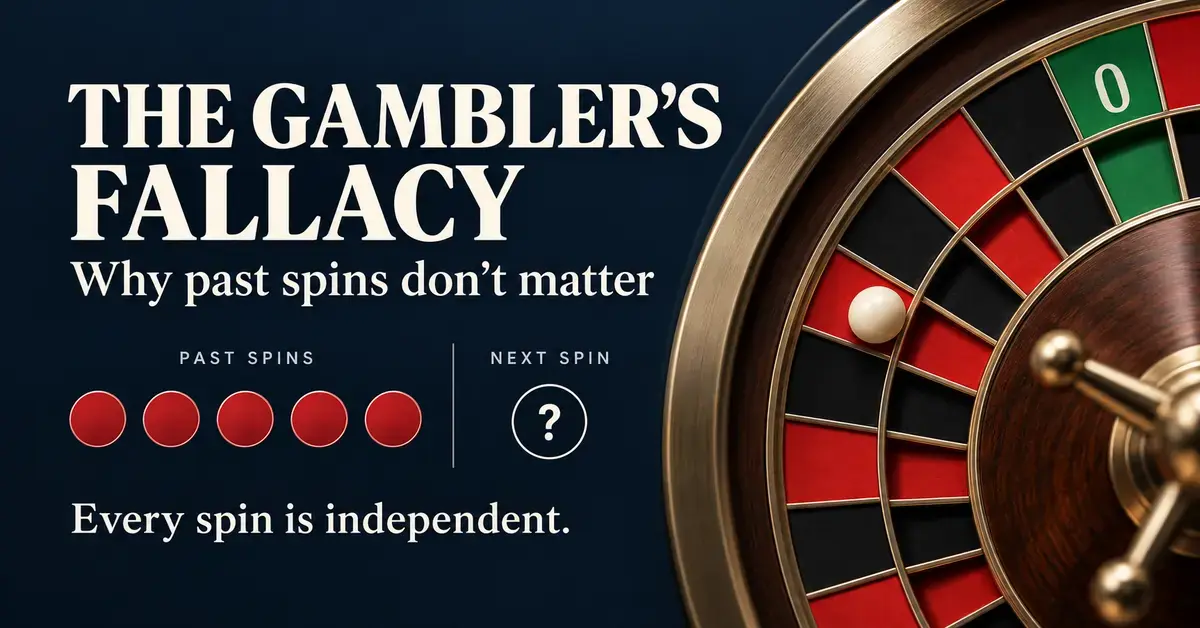
Watch a roulette wheel land on red five, six, seven times in a row and it is almost impossible not to feel that black must be “due”. That instinct feels like plain common sense — but it is a well-documented reasoning error, and over the years it has cost players fortunes. This guide explains what the error is, why every roulette spin is completely independent of the ones before it, and what the mathematics actually says about those hypnotic streaks of red or black. If you are brand new to the table, our guide on how to play roulette covers the wheel, the bets and the payouts first.
Key Points
- Every roulette spin is an independent event — the wheel and ball have no memory of previous results.
- No colour, number or section is ever “due”; the odds reset identically on every spin.
- On a single-zero (European) wheel a red or black bet wins 18/37 (~48.6%); on a double-zero (American) wheel it wins 18/38 (~47.4%).
- The green zero(s) give the house a fixed edge of 2.70% (single zero) or 5.26% (double zero) that no system removes.
- The 1913 Monte Carlo run of 26 consecutive blacks is the classic real-world example of the fallacy costing players money.
What is the gambler’s fallacy?
The gambler’s fallacy is the mistaken belief that if something happens more often than usual during a stretch of chance events, it will happen less often in the future — or the other way around. In plain terms, it is the feeling that a random outcome is somehow “owed” or “overdue” because of what came before.
It is also called the Monte Carlo fallacy (after a famous 1913 incident described below) or the “maturity of chances” fallacy. The core mistake is treating independent events — events whose outcome is not influenced by earlier outcomes — as if they were connected. A coin, a dice roll and a roulette wheel do not keep a running tally and try to balance the books.
Why every roulette spin is independent
A roulette wheel has no memory. The ball, the pockets and the mechanism have no way of “knowing” what happened on the previous spin, so the odds reset to exactly the same values every single time. Whether black has appeared once or twenty times in a row, the chance of black on the next spin is identical.
The numbers depend only on which wheel you are playing:
- European (single-zero) wheel: 37 pockets — the numbers 1 to 36 plus a single green 0. A bet on red or black wins on 18 of those 37 pockets, roughly 48.6% of the time.
- American (double-zero) wheel: 38 pockets — 1 to 36 plus a green 0 and a green 00. A red or black bet now wins on 18 of 38 pockets, roughly 47.4% of the time.
Notice that a colour bet is never a true 50/50 proposition: the green zero (or zeros) tips every wager slightly in the house’s favour. That built-in advantage is called the house edge — 2.70% on a single-zero wheel and 5.26% on a double-zero wheel — and no amount of watching past spins changes it.
Roulette Odds Reference
| Outcome | European (single zero) | American (double zero) |
|---|---|---|
| Pockets on the wheel | 37 | 38 |
| Red or black bet wins | 18/37 (~48.6%) | 18/38 (~47.4%) |
| Single number (straight-up) | 1/37 (~2.7%) | 1/38 (~2.6%) |
| House edge | 2.70% | 5.26% |
The maths behind “due” numbers
Here is where intuition and probability part ways. The chance of a single-zero wheel producing six blacks in a row, calculated before any spins, is (18/37) multiplied by itself six times — a little over 1%. Because that combined figure is small, it feels as though a long black run should not continue.
But once five blacks have already landed, those spins are history. The only question left is the next spin, and its chance of black is simply 18/37 again — the same as it was on the very first spin. The unlikely part (getting five in a row) has already happened; it does not lower the odds of the sixth. Confusing the probability of a whole sequence with the probability of the next single event is the mathematical heart of the fallacy.
The 1913 Monte Carlo streak
The most famous real-world example gave the fallacy its nickname. On 18 August 1913, at the Monte Carlo Casino, a roulette ball landed on black an astonishing 26 times in succession — an outcome so rare it would be expected roughly once in 137 million spins on a single-zero wheel.
As the run grew, players crowded the table convinced that red was overdue, and bet against black in ever-larger amounts. Because each spin remained an independent 18/37 chance, black kept coming, and gamblers reportedly lost millions of francs chasing a “correction” that probability never promised. The wheel was behaving normally the whole time; only the players’ expectations were faulty.
The law of large numbers vs. the “law of averages”
People often defend the fallacy by invoking a vague “law of averages” — the idea that results must even out. There is a real principle here, but it works differently from how gamblers imagine.
The genuine law of large numbers says that over a very large number of spins, the proportion of reds and blacks will tend to move closer to their true probabilities. Crucially, the wheel does not achieve this by reversing short-term streaks. It achieves it by dilution: as thousands more spins pile up, any early imbalance becomes a smaller and smaller fraction of the total and simply fades into insignificance. The wheel never “pays back” a run of black by producing extra reds.
How the fallacy shows up at the table
The gambler’s fallacy rarely announces itself. It hides inside decisions that feel reasonable in the moment:
- Chasing a colour: loading bets on red because black “has to break” after a streak.
- Avoiding recent numbers: refusing to bet a number that just hit, on the belief it cannot repeat — even though its odds are unchanged.
- Reading the scoreboard: treating the electronic display of recent results as a pattern to exploit, when it is only a record of independent outcomes.
- Justifying a betting system: using past spins to decide when a progression such as the Martingale is “safe” to start.
None of these change the underlying probability of the next spin, and none reduce the house edge.
The flip side: the hot-hand fallacy
The mirror image of the gambler’s fallacy is the hot-hand fallacy — believing a streak will continue because the wheel is “hot” for a colour or a section. Both errors spring from the same root: reading meaning into random independent results. One says the streak must end; the other says it must go on. For a fair roulette wheel, both are equally mistaken, because the next spin does not care which story you prefer.
What this means for betting systems
Popular progressions like the Martingale (doubling your stake after each loss) are sometimes marketed as a way to beat roulette. They rely, directly or indirectly, on the assumption that a losing run cannot last much longer — the gambler’s fallacy in disguise. Because each spin is independent, a long adverse streak is always possible, and table limits plus a finite bankroll mean stakes can balloon beyond what a player can cover. No staking pattern removes the green-zero house edge; it only rearranges the size and timing of wins and losses. Roulette remains a game of chance, and the mathematically honest expectation on every bet is a small loss over time.
Friskrivning
This article is for general information only and is not betting, financial or professional advice. Roulette is a game of chance with a built-in house edge; no strategy, pattern-reading or betting system can change the odds of a spin or guarantee a profit, and over time the expected result of play is a loss. You must be of legal gambling age in your province or territory (18 or 19, depending on where you live) to gamble in Canada. If gambling is affecting you or someone you know, free, confidential help is available in Canada from ConnexOntario (1-866-531-2600, available 24/7) and the Responsible Gambling Council. Please play responsibly and only with money you can afford to lose.
Sources
- Wizard of Odds — Roulette Basics: Rules, Bets and Variations
- Statistics By Jim — Gambler’s Fallacy: Overview & Examples
- Duke University Mathematics — Gambler’s Fallacy
- PrimeDope — In-depth Guide to European Roulette Odds
- Responsible Gambling Council (Canada)
- ConnexOntario — Gambling, Alcohol and Drug Help
Vanliga frågor (FAQ)
What is the gambler’s fallacy in roulette?
It is the mistaken belief that past spins influence future ones — for example, thinking that after several blacks in a row, red is “due”. In reality every spin is an independent event with the same odds, so previous results never change what is likely to come next.
Does a colour become “due” after a long streak?
No. The wheel has no memory. On a single-zero wheel, red or black each win about 48.6% of the time on every spin regardless of how many times either has just appeared. A streak, no matter how long, does not make the opposite result any more likely.
Can tracking past spins improve my roulette odds?
Not on a fair wheel. Scoreboards showing recent numbers only record independent outcomes; they contain no information about the next spin. Betting based on them does not lower the house edge of 2.70% (single zero) or 5.26% (double zero).
What is the difference between the gambler’s fallacy and the hot-hand fallacy?
The gambler’s fallacy assumes a streak must end (“red is overdue”), while the hot-hand fallacy assumes a streak will continue (“black is hot”). Both misread random independent results, and both are equally wrong for a fair roulette wheel.
Does the law of large numbers mean the wheel evens out?
Not in the way many players think. Over a huge number of spins the proportion of reds and blacks drifts toward its true value, but this happens because early imbalances are diluted by later spins — not because the wheel reverses short-term streaks to “balance” them.
