
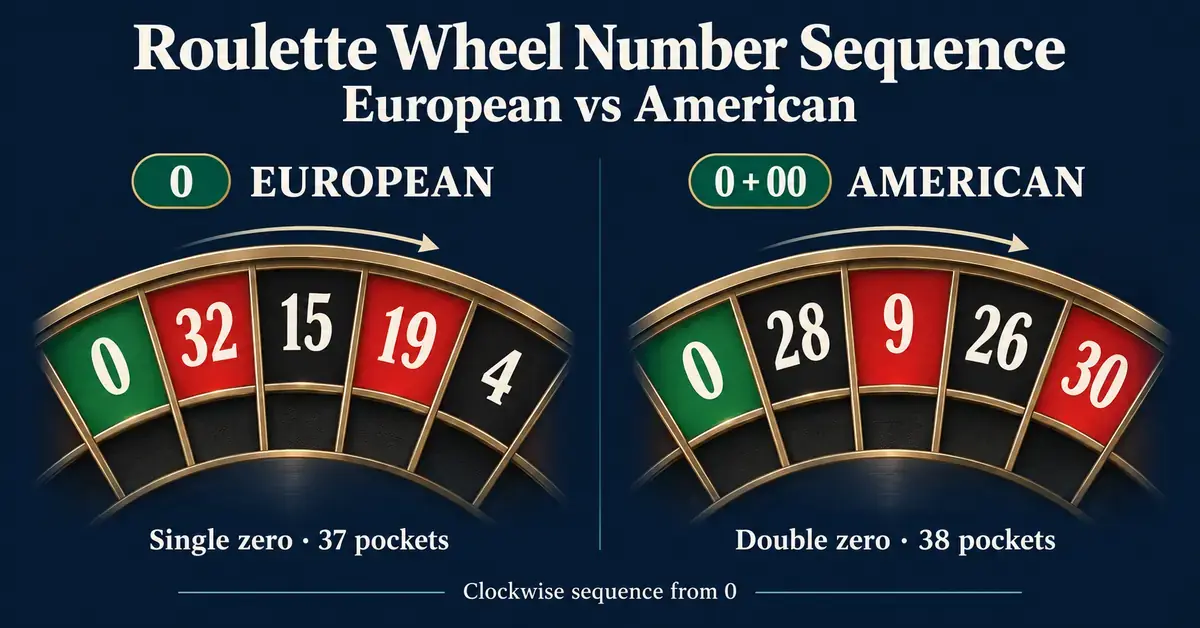
Glance at a roulette wheel and the numbers look random: 32 sits next to 15, then 19, then 4. There is no counting up, no obvious pattern. Yet the order is fixed and deliberate, and it is not the same on every wheel. The two layouts you will meet in Canadian casinos and online — the European (single-zero) wheel and the American (double-zero) wheel — use different number sequences built on different logic. This guide lists both orders in full, explains why the pockets are arranged the way they are, and clears up what the sequence does (and does not) mean for your chances.
Key Points
- European (single-zero) order, clockwise from 0: 32, 15, 19, 4, 21, 2, 25, 17, 34, 6, 27, 13, 36, 11, 30, 8, 23, 10, 5, 24, 16, 33, 1, 20, 14, 31, 9, 22, 18, 29, 7, 28, 12, 35, 3, 26.
- American (double-zero) order, clockwise from 0: 28, 9, 26, 30, 11, 7, 20, 32, 17, 5, 22, 34, 15, 3, 24, 36, 13, 1, 00, 27, 10, 25, 29, 12, 8, 19, 31, 18, 6, 21, 33, 16, 4, 23, 35, 14, 2.
- Numbers are scattered to balance colour, odd/even and high/low around the wheel — not to be read in order.
- The layout does not affect the odds: every pocket is equally likely on a fair wheel.
- What changes the odds is the number of green pockets — one (2.70% edge) versus two (5.26% edge).
Why roulette numbers are not in order
A roulette wheel is not designed to be read like a number line. It is designed so that the different properties of the numbers are spread as evenly as possible around the rim. Wheel makers try to balance four things around the circle:
- Colour: red and black pockets alternate all the way around (the zero, and the double zero on American wheels, are green).
- Odd and even: odd and even numbers are distributed so that they rarely cluster.
- High and low: low numbers (1–18) and high numbers (19–36) are mixed so that you seldom get long runs of one group.
- Adjacency: numbers that are close in value — or that share a column on the betting table — are pushed to opposite sides of the wheel.
The result looks chaotic but is carefully engineered. Importantly, this balancing is about the physical layout only. On a fair, well-maintained wheel every pocket is equally likely on every spin, so the arrangement does not change your odds — it simply spreads the categories out visually and makes the wheel look and feel balanced.
The European (single-zero) wheel sequence
The European wheel — the same design used on French tables — has 37 pockets: the numbers 1 to 36 plus a single green zero. Starting at 0 and reading clockwise, the order is:
0 – 32 – 15 – 19 – 4 – 21 – 2 – 25 – 17 – 34 – 6 – 27 – 13 – 36 – 11 – 30 – 8 – 23 – 10 – 5 – 24 – 16 – 33 – 1 – 20 – 14 – 31 – 9 – 22 – 18 – 29 – 7 – 28 – 12 – 35 – 3 – 26
Every reputable single-zero wheel worldwide uses this exact order. Interestingly, no one knows for certain who devised it or why it takes this particular form — beyond the good spread of high/low and odd/even numbers, there is no simple rule that generates the whole sequence. It is one of gambling’s small unsolved mysteries.
Wheel sectors and call bets
Because the European order is fixed, French and European tables give names to groups of numbers that sit next to each other on the wheel (not on the betting layout). These are the classic “call bets” or “announced bets,” and they only make sense once you know the sequence above:
- Voisins du Zéro (neighbours of zero): the 17 numbers spanning from 22 round to 25, passing through the zero — 22, 18, 29, 7, 28, 12, 35, 3, 26, 0, 32, 15, 19, 4, 21, 2, 25. Placed with 9 chips.
- Tiers du Cylindre (third of the wheel): the 12 numbers on the opposite side to zero — 27, 13, 36, 11, 30, 8, 23, 10, 5, 24, 16, 33. Placed with 6 chips.
- Orphelins (orphans): the 8 numbers left over between the other two sectors — 17, 34, 6 and 1, 20, 14, 31, 9. Placed with 5 chips.
- Jeu Zéro (zero game): a smaller cluster right around the zero — 12, 35, 3, 26, 0, 32, 15. Placed with 4 chips.
These bets are a convenience for covering a slice of the wheel in one call. They do not carry any better odds than the same numbers bet individually — the house edge is identical.
The American (double-zero) wheel sequence
The American wheel has 38 pockets: 1 to 36, a green zero, and a second green double zero (00). Starting at 0 and reading clockwise, the order is:
0 – 28 – 9 – 26 – 30 – 11 – 7 – 20 – 32 – 17 – 5 – 22 – 34 – 15 – 3 – 24 – 36 – 13 – 1 – 00 – 27 – 10 – 25 – 29 – 12 – 8 – 19 – 31 – 18 – 6 – 21 – 33 – 16 – 4 – 23 – 35 – 14 – 2
How the American layout is built differently
The American wheel follows a much more mechanical rule than the European one:
- Zero and double zero sit directly opposite each other, splitting the wheel into two arcs of 18 numbers.
- Consecutive numbers face each other. Across the wheel from most odd numbers you will find the next number up — for example, 1 is opposite 2, so each pair straddles the centre.
- The two halves are near mirror images of one another, which makes the wheel look symmetrical but does not give the same smooth high/low and odd/even mix that the European order achieves.
The practical takeaway is simpler than the layout: that extra green pocket is the reason American roulette is a worse bet, as the next section explains.
European vs American: what the difference costs you
The number sequence is a matter of design; the number of green pockets is what actually affects your money. A straight-up bet on any single number pays 35 to 1 on both wheels. But the true odds differ because the American wheel has one more losing pocket.
Comparison
| Feature | European wheel | American wheel |
|---|---|---|
| Total pockets | 37 | 38 |
| Green pockets | 1 (0) | 2 (0 and 00) |
| House edge (all bets) | About 2.70% | About 5.26% |
| Even-money edge with la partage / en prison | About 1.35% | Not offered |
| Layout logic | Traditional scattered order; strong high/low and odd/even balance | Mechanical mirror layout; 0 and 00 opposite, consecutive numbers face each other |
| Straight-up payout | 35 to 1 | 35 to 1 |
- European (single zero): 37 pockets, house edge of about 2.70% on every bet.
- American (double zero): 38 pockets, house edge of about 5.26% on every bet — nearly double.
Some single-zero tables add the la partage or en prison rule, common on French wheels. On even-money bets (such as red/black or odd/even), these rules give back half your stake, or lock it for one more spin, when the ball lands on zero. Either version cuts the house edge on those bets to roughly 1.35%. Where you have the choice, a single-zero wheel — ideally with one of these rules — is always the better-value game.
Common myths about the number sequence
Knowing the wheel order is genuinely useful for understanding call bets and reading the layout, but it is often oversold. A few things it will not do:
- It will not predict the next number. Each spin is independent; the previous result has no effect on where the ball lands next.
- Betting “neighbours” does not beat the house. Covering a wheel sector spreads your stake over more numbers, but the edge on those chips is exactly the same as betting them anywhere else.
- Memorising the order is not a system. It helps you place announced bets quickly; it does not tilt the odds in your favour.
- Colour or number “streaks” are not due to end. Because spins are independent, a long run of red does not make black more likely on the next spin.
If you want the fundamentals of bets, payouts and the wheel in one place, our roulette guide for Canadian players is a good starting point.
Which wheel to look for
Wherever you play — in a land-based Canadian casino or at a licensed online table — the single number that matters most is how many green pockets the wheel has. One green pocket (single zero) is the European wheel and the better-value game; two green pockets (0 and 00) is the American wheel with roughly double the house edge. Some game menus also list a triple-zero wheel with three green pockets, which pushes the edge higher still and is best avoided. The number sequence itself is standard within each type, so once you know which wheel you are looking at, you already know the order.
Responsible Gambling
Roulette is a game of chance with a built-in mathematical house edge on every bet; over time the game is designed to favour the casino, and no knowledge of the wheel sequence or any betting system changes that. The legal gambling age in Canada is 19 in most provinces and 18 in Alberta, Manitoba and Quebec. Set a budget you can afford to lose, treat any losses as the cost of entertainment, and never bet to chase money you have already lost. If gambling is causing you or someone you know harm, free, confidential help is available through the Responsible Gambling Council and, in Ontario, ConnexOntario (1-866-531-2600), which operates 24/7.
Sources
Frequently Asked Questions (FAQ)
What is the number sequence on a European roulette wheel?
Starting from zero and reading clockwise, the order is 0, 32, 15, 19, 4, 21, 2, 25, 17, 34, 6, 27, 13, 36, 11, 30, 8, 23, 10, 5, 24, 16, 33, 1, 20, 14, 31, 9, 22, 18, 29, 7, 28, 12, 35, 3 and 26. This single-zero order is the same on every standard European and French wheel.
How is the American wheel sequence different?
The American wheel has an extra green double-zero pocket and a different order: 0, 28, 9, 26, 30, 11, 7, 20, 32, 17, 5, 22, 34, 15, 3, 24, 36, 13, 1, 00, 27, 10, 25, 29, 12, 8, 19, 31, 18, 6, 21, 33, 16, 4, 23, 35, 14 and 2. The zero and double zero sit opposite each other, and consecutive numbers are placed across the wheel from one another.
Why are the numbers not in numerical order?
The order is chosen to spread the colours, odd and even numbers, and high and low numbers evenly around the rim so the wheel looks and feels balanced. On a fair wheel every pocket is still equally likely, so the arrangement does not affect the outcome of any single spin.
Does knowing the sequence improve my chances of winning?
No. Each spin is independent and the house edge is fixed by the number of pockets, not by the order. Knowing the sequence only helps you understand sector or “call” bets and read the wheel; it does not give you an advantage.
Which wheel gives better odds, European or American?
The European single-zero wheel is better, with a house edge of about 2.70% compared with about 5.26% on the American double-zero wheel. Single-zero tables that also offer the la partage or en prison rule lower the edge on even-money bets to about 1.35%.
