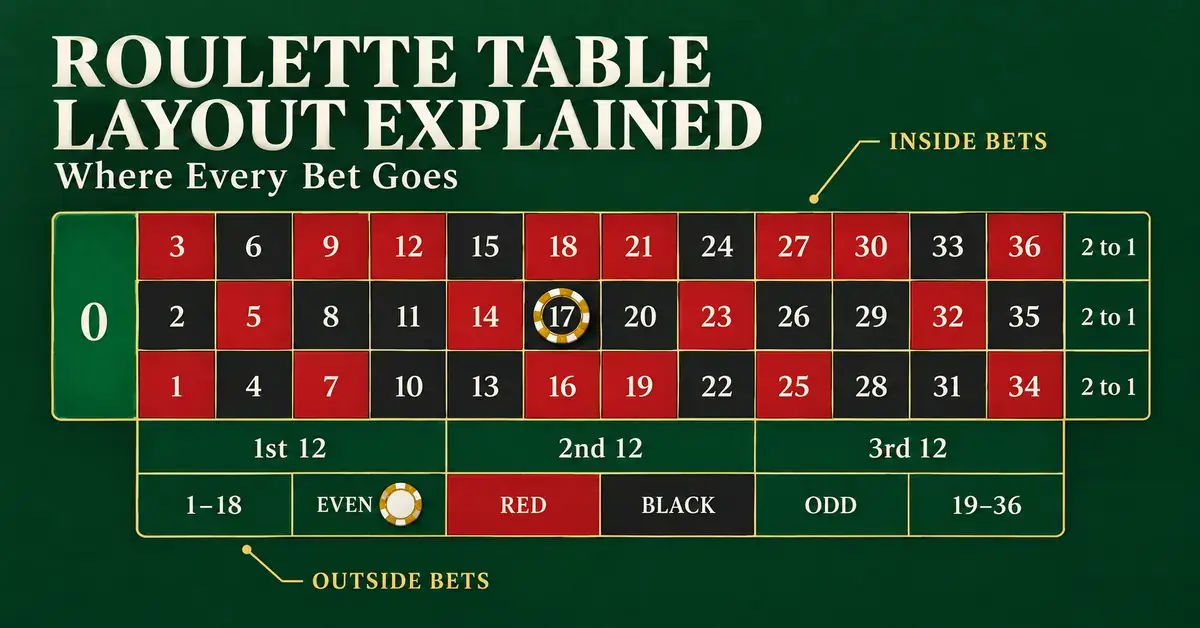
The first time you look at a roulette table it can seem like a wall of numbers, colours and boxes. In reality the felt is a simple, logical map: every square, line and outer box corresponds to a specific outcome the wheel can produce, and where you place your chips decides exactly which numbers you are backing and how much a win pays. This guide walks through the whole layout piece by piece — the number grid, the inside bets, the outside bets and the optional racetrack — so you can read any roulette table with confidence, whether it is European, American or French.
Key Points
- The roulette table is a map of outcomes: a central grid of numbers 1–36 in 3 columns and 12 rows, surrounded by group-bet boxes.
- Inside bets sit on the numbers (straight up 35:1, split 17:1, street 11:1, corner 8:1, six line 5:1) — few numbers, big payouts.
- Outside bets sit around the grid (red/black, odd/even, high/low pay 1:1; columns and dozens pay 2:1) — many numbers, small payouts.
- The green 0 (and 00 on American tables) belongs to no outside bet and creates the house edge: 2.70% European, 5.26% American.
- The table order differs from the wheel order; a racetrack lets you bet on wheel sections via called bets like Voisins du Zéro.
What a roulette table actually shows
A roulette table has two parts: the wheel, where the ball is spun, and the betting layout, the printed felt where you place chips. The layout is not a picture of the wheel — it is an organised grid of every possible result. Understanding it means knowing two families of wagers:
- Inside bets — placed on the central grid of individual numbers or on the lines between them. They cover few numbers, win rarely and pay a lot.
- Outside bets — placed in the boxes around the grid on large groups such as colours, columns or dozens. They cover many numbers, win often and pay a little.
Every bet on the felt is one of these two types. Once you can tell them apart, the rest of the table falls into place. If you are brand new to the game, the roulette-guide.ca homepage is a good starting point for the wider basics before you sit down.
The number grid: the heart of the layout
The centre of the table is a rectangle of the numbers 1 to 36 laid out in three columns and twelve rows. Reading across each row you get consecutive trios — 1-2-3 on the top row, then 4-5-6, and so on down to 34-35-36. The numbers alternate red and black in a fixed pattern (the green zero and, on American tables, the green double zero are the only exceptions).
The green 0 sits at the top of the grid, at the end nearest the wheel. An American table adds a second green pocket, 00, alongside it. This single design difference is the most important thing on the whole table, because it changes the odds of every bet — more on that below.
Inside bets: wagers on the numbers
Inside bets live on and between the printed numbers. You signal which one you mean purely by where you set the chip.
The individual inside bets
- Straight up — a chip fully inside one number’s box, backing that single number. Pays 35:1.
- Split — a chip on the line shared by two touching numbers, backing both. Pays 17:1.
- Street — a chip on the outer edge of a row, backing all three numbers in that row. Pays 11:1.
- Corner (square) — a chip on the point where four numbers meet, backing all four. Pays 8:1.
- Six line (double street) — a chip on the outer edge where two rows meet, backing all six numbers. Pays 5:1.
- Basket — an American-table-only bet on 0, 00, 1, 2 and 3 at once. Pays 6:1, but it carries a much higher house edge (about 7.9%) and is generally best avoided.
Notice the pattern: the more numbers a bet covers, the lower the payout, because it wins more often. A straight-up win on a single number is rare, which is why it pays the most.
Outside bets: wagers on the groups
Around the number grid sit the outside boxes. These never include the zero (or double zero), so if the ball lands on green, all outside bets lose — the reason the zero exists in the first place.
Even-money bets
Along the long side of the grid are six boxes that each cover eighteen numbers and pay 1:1 (your stake back plus the same amount again):
- Red or Black — the colour of the winning number.
- Odd or Even — the parity of the number.
- 1–18 (Low) or 19–36 (High) — the half of the range it falls in.
Columns and dozens
Two more groups each cover twelve numbers and pay 2:1:
- Columns — the three “2 to 1” boxes at the bottom end of the grid, each backing one full vertical column of twelve numbers.
- Dozens — the boxes marked 1st 12 (1–12), 2nd 12 (13–24) and 3rd 12 (25–36), each backing that block of twelve.
The table below summarises where every standard bet goes and what it returns.
Bet Types and Payouts
| Bet | Type | Numbers covered | Payout | Win chance (European) |
|---|---|---|---|---|
| Straight up | Inside | 1 | 35:1 | 2.70% |
| Split | Inside | 2 | 17:1 | 5.41% |
| Street | Inside | 3 | 11:1 | 8.11% |
| Corner | Inside | 4 | 8:1 | 10.81% |
| Six line | Inside | 6 | 5:1 | 16.22% |
| Basket (American only) | Inside | 5 (0, 00, 1, 2, 3) | 6:1 | 13.16% |
| Column | Outside | 12 | 2:1 | 32.43% |
| Dozen | Outside | 12 | 2:1 | 32.43% |
| Red / Black | Outside | 18 | 1:1 | 48.65% |
| Odd / Even | Outside | 18 | 1:1 | 48.65% |
| 1–18 / 19–36 | Outside | 18 | 1:1 | 48.65% |
Win chances shown are for a single-zero (European) wheel; American double-zero win chances are slightly lower for every bet.
Why the table order differs from the wheel order
A common source of confusion for beginners: the numbers run neatly 1, 2, 3 across the table, but on the wheel they are scattered (on a European wheel the order beside zero is 0, 32, 15, 19, 4, 21, and so on). This is deliberate. The table is arranged for easy, tidy betting; the wheel is arranged to spread high/low, odd/even and red/black roughly evenly around the rim so no section is “hot.” The two orders serve different purposes, which is exactly why one extra betting area exists to bridge them — the racetrack.
The racetrack and called bets
Many European and French tables (and their online versions) include an oval racetrack off to the side. It mirrors the order of numbers on the wheel rather than on the felt, letting you bet on sections of the wheel in one action. These are known as called or announced bets, and the main fixed ones are:
- Voisins du Zéro (neighbours of zero) — the 17 numbers around and including the zero.
- Tiers du Cylindre (thirds of the wheel) — the 12 numbers on the section opposite zero.
- Orphelins (orphans) — the 8 numbers left over between the other two groups.
- Jeu Zéro (zero game) — a smaller 7-number cluster right around the zero.
Racetrack bets are just shortcuts made of ordinary straight-up and split bets; they do not change the odds, only the convenience. American tables usually have no racetrack.
European, American and French tables compared
The layouts look almost identical, but small differences matter a great deal:
- European — one green zero, 37 pockets in total. The house edge on almost every bet is 2.70%.
- American — both 0 and 00, 38 pockets. The extra green pocket roughly doubles the house edge to 5.26%, so, all else equal, a single-zero table is the friendlier choice for the player.
- French — a single-zero layout (often with the outside boxes labelled in French) that adds the La Partage or En Prison rule. When the ball lands on zero, these rules give you back half of an even-money bet (La Partage) or hold it for one more spin (En Prison), cutting the house edge on those bets to about 1.35%.
House edge: why the zero matters
The payouts are calculated as if the zero did not exist. A straight-up bet pays 35:1, but on a European wheel there are 37 pockets, not 36 — that gap is the house edge, and it is the same on every standard bet. The double zero on an American table adds a 38th pocket without changing any payout, which is why its edge is nearly double. No bet placement, colour choice or pattern of chips changes this built-in margin; it is fixed by the design of the layout itself.
Common beginner mistakes at the table
- Misreading a chip’s position. A chip nudged onto a line becomes a split or street instead of a straight up. Place chips deliberately and check before the dealer waves off betting.
- Assuming outside bets include the zero. They never do — green loses for red/black, odd/even and high/low alike.
- Choosing an American table when a European one is available. The higher house edge costs you nothing to avoid.
- Chasing “due” numbers. Each spin is independent; the layout has no memory, and past results never affect the next spin.
Reading the table: a quick walkthrough
Put it all together: to back a single number you place a chip fully inside its box (straight up). To back a colour you use the red or black diamond. To back a third of the numbers you use a column or dozen box. To back a wheel section in one move you use the racetrack. Once you see the felt as a map of outcomes rather than a jumble of squares, every roulette table — physical or online — reads the same way. This makes the layout ideal for complete beginners who want to understand what they are betting on before risking a cent, and equally useful for players moving from online to a live casino table for the first time.
Responsible gambling
This article is informational only and is not gambling advice or encouragement to play. Roulette is a game of chance with a built-in house edge; no table layout, bet placement or system can overcome it, and outcomes cannot be predicted. In Canada the legal gambling age is 18 in Alberta, Manitoba and Quebec, and 19 in all other provinces and territories.
If gambling is causing you concern, free confidential help is available across Canada. Contact the Responsible Gambling Council, or call ConnexOntario free at 1-866-531-2600 (24/7). Set a budget and time limit before you play, and never bet money you cannot afford to lose.
Sources
- Casino.org – Roulette Bets Explained (payouts and probabilities)
- Casino.org – The Roulette Table Explained
- Wizard of Odds – Roulette Basics, Rules and House Edge
- DraftKings Casino – European vs American Roulette
- Responsible Gambling Council – Help for Canadians
- ConnexOntario – Free 24/7 Gambling Helpline
Frequently asked questions (FAQ)
What is the difference between inside and outside bets?
Inside bets are placed on the central grid, on single numbers or small combinations; they cover few numbers, win less often and pay more (up to 35:1). Outside bets are placed in the boxes around the grid on large groups such as red/black, columns or dozens; they cover many numbers, win more often and pay less (1:1 or 2:1).
Why is the number order on the table different from the wheel?
The table is arranged in a tidy 1-to-36 grid so betting is quick and clear. The wheel scatters the numbers so that high/low, odd/even and red/black are spread evenly around the rim. They serve different purposes, and the racetrack area exists to let you bet in wheel order when a table offers it.
Which roulette table gives the best odds?
A single-zero table is better for the player than a double-zero one: European roulette carries a 2.70% house edge versus 5.26% on American. A French table with La Partage or En Prison is best of all on even-money bets, lowering their edge to about 1.35%.
What are called or announced bets?
They are pre-set groups of numbers based on wheel position rather than table position, placed using the oval racetrack found on many European and French tables. Examples include Voisins du Zéro, Tiers du Cylindre and Orphelins. They are shortcuts built from ordinary straight-up and split bets and do not change the odds.
Does where I place my chips change my chances of winning?
Placement decides which numbers you are backing and what a win pays, but it does not alter the house edge, which is fixed by the wheel’s design. Every spin is independent and random, so no bet position, pattern or system can improve your long-run chances.
