
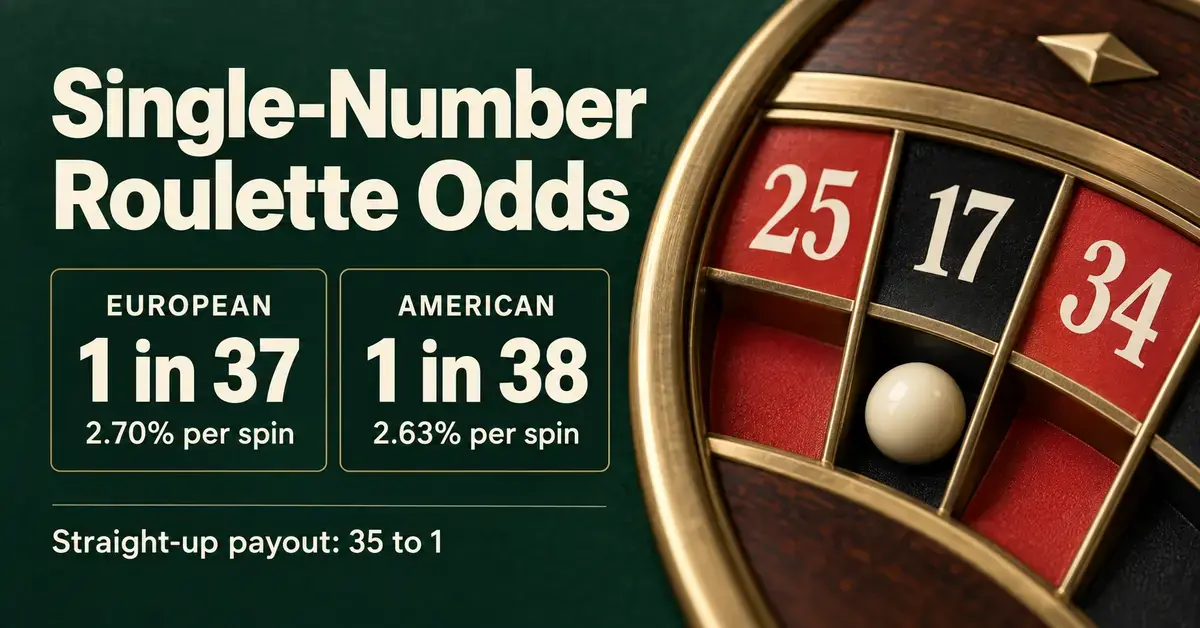
Betting your whole stake on one number is the most eye-catching wager in roulette — it pays 35 times your bet if the ball lands where you called it. But that big payout comes with the longest odds on the table. On a European wheel you have roughly a 1 in 37 chance (about 2.70%) of hitting a single number on any given spin, and on an American wheel it drops to about 1 in 38 (2.63%). This guide breaks down exactly where those numbers come from, why the payout is 35 to 1 rather than the mathematically “fair” amount, and what the odds really mean over many spins.
A single-number bet is also called a straight-up bet. It is an “inside” bet, placed directly on one of the numbered squares on the betting layout. If you are new to the layout and the flow of a round, our how to play roulette guide covers the basics first.
Key Facts
- Bet type: Straight-up (single number), an inside bet
- Chance per spin — European/French wheel: 1 in 37 (about 2.70%)
- Chance per spin — American wheel: 1 in 38 (about 2.63%)
- Payout: 35 to 1 on every wheel type
- True odds (European): 36 to 1
- House edge: 2.70% (European/French) vs 5.26% (American)
- Winning $10 bet returns: $360 ($350 profit + $10 stake)
The short answer: how likely is a single number?
A roulette wheel is divided into numbered pockets, and the ball settles into exactly one of them each spin. The chance of hitting any specific number is simply one pocket divided by the total number of pockets on the wheel:
- European / French wheel (37 pockets): 1 ÷ 37 = 0.027027, or about 2.70% per spin.
- American wheel (38 pockets): 1 ÷ 38 = 0.026316, or about 2.63% per spin.
Put another way, on a European wheel you would expect to hit a chosen number roughly once every 37 spins on average, and once every 38 spins on an American wheel. “On average” is the important phrase — it does not mean the number is guaranteed to arrive within that window, as we explain further down.
Why the wheel type matters
The only thing that changes the odds of hitting a single number is how many pockets the wheel has. The numbers 1 to 36 are identical across every version; the difference is the zero (or zeroes).
European roulette (single zero)
A European wheel has 37 pockets: the numbers 1 to 36 plus a single green 0. That gives you the 1-in-37 (2.70%) chance on a straight-up bet. Because it has fewer pockets, the European wheel offers better odds than the American version for exactly the same payout.
American roulette (double zero)
An American wheel adds a second green pocket, the 00, for 38 pockets in total. That extra pocket lowers your chance of hitting a single number to 1 in 38 (2.63%) and, crucially, nearly doubles the house’s built-in advantage without improving the payout. If you have a choice, the European wheel is the better bet for a straight-up wager.
French roulette
French roulette uses the same single-zero wheel as European roulette, so the odds of hitting a single number are the same 2.70%. French tables often add the la partage and en prison rules, which return part of a losing bet when the ball lands on zero — but those rules apply only to even-money outside bets (such as red/black), not to single-number bets. For a straight-up wager, a French wheel behaves exactly like a European one.
True odds versus the payout: where the house edge hides
Here is the part many players miss. The true odds of a single number on a European wheel are 36 to 1 — there are 36 ways to lose and 1 way to win. A perfectly fair game would therefore pay 36 to 1. Instead, casinos pay 35 to 1. That one-unit gap is the house edge, the long-run mathematical advantage the casino keeps.
- European wheel: true odds 36:1, payout 35:1 → house edge of 1/37 = 2.70%.
- American wheel: true odds 37:1, payout 35:1 → house edge of 2/38 = 5.26%.
Notice the payout is 35 to 1 on both wheels, but the American wheel makes you beat longer true odds for the same reward. That is why its house edge is almost twice as large.
What a single-number bet pays
“35 to 1” means you win 35 units of profit for every 1 unit staked, and you also keep your original stake. So a winning bet returns 36 units in total.
- Stake $10 and win: you receive $350 in winnings plus your $10 back = $360 returned.
- Stake $5 and win: $175 plus your $5 = $180 returned.
To see the house edge in action, imagine betting $10 on the same number for 37 spins on a European wheel. You wager $370 in total and, on average, expect to win once. That single win returns $360 — a net loss of $10 across $370 wagered, which is exactly 2.70%. On an American wheel the same exercise over 38 spins wagers $380 for one expected $360 return, a $20 loss, or 5.26%.
The odds over many spins
A 2.70% chance sounds tiny, but a chosen number becomes far more likely to appear at least once as spins add up. Because each spin is independent, you multiply the chance of it not appearing:
- Chance a specific number appears at least once in 37 spins (European): about 63.7%.
- Chance it appears at least once in 100 spins: about 93.5%.
- Chance the same number hits twice in a row: (1/37) × (1/37) = 1 in 1,369, roughly 0.073%.
This is also why chasing a single number for many spins does not beat the house: while the number grows more likely to show up eventually, you are paying the 2.70% edge on every wager along the way.
How a single number compares with other inside bets
You do not have to cover just one number. Inside bets let you back small groups of numbers at once; the more numbers you cover, the higher your chance of winning and the smaller the payout. The table below compares them on a European wheel.
Inside Bet Comparison
| Inside bet | Numbers covered | Chance per spin (European) | Payout |
|---|---|---|---|
| Straight-up (single number) | 1 | 2.70% | 35 to 1 |
| Split | 2 | 5.41% | 17 to 1 |
| Street | 3 | 8.11% | 11 to 1 |
| Corner | 4 | 10.81% | 8 to 1 |
| Six line | 6 | 16.22% | 5 to 1 |
Every one of these bets carries the same 2.70% house edge on a European wheel, so spreading your chips across more numbers does not change the long-run math — it only trades a rarer, bigger win for a more frequent, smaller one.
Common misconceptions
- “My number is due.” The wheel has no memory. After a number has gone missing for 100 spins, its chance next spin is still 2.70% — exactly the same as always. Believing otherwise is the classic gambler’s fallacy.
- “The payout makes it a fair bet.” It does not. The 35:1 payout is deliberately one unit short of the 36:1 true odds, which is precisely how the casino profits.
- “Betting more numbers lowers the edge.” It lowers your volatility (wins come more often) but the percentage the house keeps stays the same.
- “A system can beat single-number odds.” No betting pattern changes the probability of an independent spin. Systems can shape how your bankroll rises and falls, not the underlying odds.
Who a single-number bet suits
A straight-up bet is best understood as a low-frequency, high-reward wager. It suits players who enjoy the thrill of a large payout and accept that most spins will lose. If you prefer steadier, more frequent (but smaller) returns, outside bets such as red/black or the broader inside bets above are a gentler fit. Whatever you choose, the European or French single-zero wheel gives you better odds than the American double-zero wheel for the same 35:1 reward. For more explainers, browse the rest of Roulette Guide Canada.
Disclaimer
This article is for information and entertainment only and is not betting advice. Roulette is a game of chance with a permanent mathematical house edge; no bet, pattern or system can overcome it, and past spins never influence future ones. Only ever wager money you can afford to lose. You must be of legal gambling age in your province or territory (18 or 19 depending on where you live in Canada). If gambling is causing you or someone you know harm, free, confidential help is available in Canada from ConnexOntario (1-866-531-2600, available 24/7) and the Responsible Gambling Council.
Sources
Frequently Asked Questions (FAQ)
What are the odds of hitting a single number in roulette?
On a European or French wheel with 37 pockets, the chance is 1 in 37, or about 2.70% per spin. On an American wheel with 38 pockets it is 1 in 38, or about 2.63% per spin.
How much does a single number pay in roulette?
A straight-up bet pays 35 to 1. You win 35 units for every 1 unit staked and keep your original stake, so a winning $10 bet returns $360 in total ($350 profit plus your $10).
Why is the payout 35 to 1 and not 36 to 1?
The true odds on a European wheel are 36 to 1, so a fair game would pay 36 to 1. Casinos pay 35 to 1 instead, and that one-unit difference is the house edge — 2.70% on a single-zero wheel and 5.26% on a double-zero wheel.
Is a single number more likely to hit after a long absence?
No. Each spin is independent and the wheel has no memory, so the chance is 2.70% (European) on every spin regardless of how long a number has been missing. Assuming otherwise is the gambler’s fallacy.
Which wheel gives the best odds on a single number?
The European or French single-zero wheel. It offers a 1-in-37 chance for the same 35:1 payout, giving a 2.70% house edge, versus 1-in-38 and a 5.26% edge on the American double-zero wheel.
