
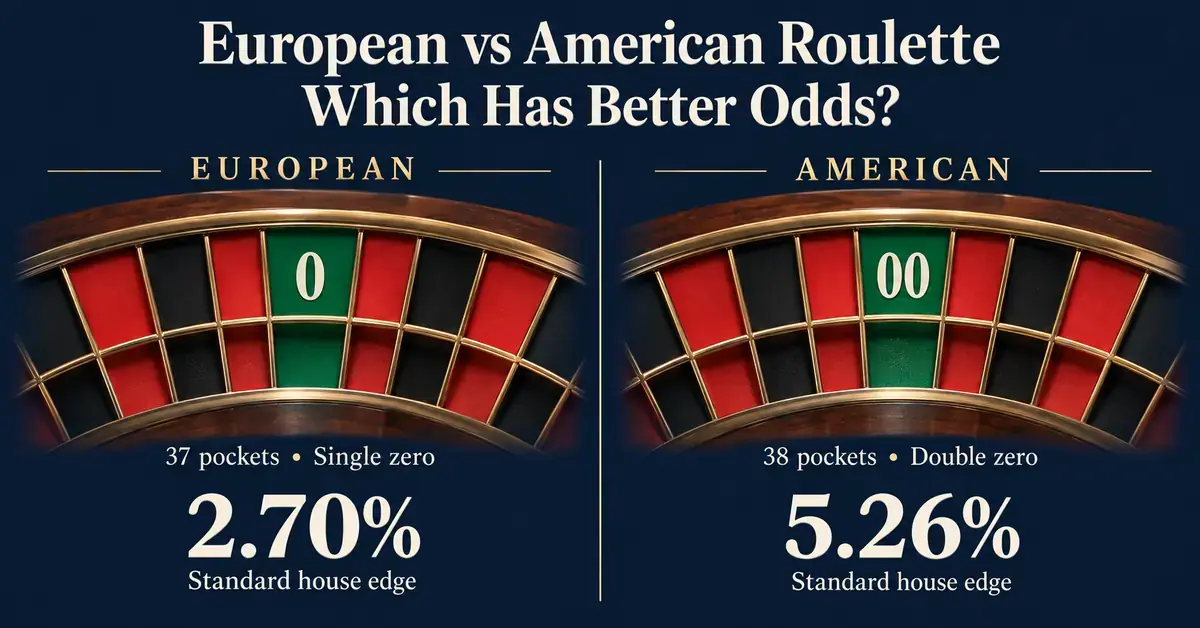
Roulette looks the same wherever you play it: a spinning wheel, a bouncing ball and a grid of numbers to bet on. Look closer, though, and you will find two main versions on Canadian casino floors and gaming apps — European roulette and American roulette. The gap between them comes down to a single green pocket, and that one pocket shifts your odds more than any betting system ever could. This guide explains exactly how the two games differ, what each one costs you over time, and why the choice matters on every spin.
The one difference that matters: single zero vs double zero
Both games use numbers 1 to 36, coloured red and black, plus green zero pockets. The difference is how many green pockets there are.
- European roulette has 37 pockets: the numbers 1–36 and a single zero (0).
- American roulette has 38 pockets: the numbers 1–36, a single zero (0) and a double zero (00).
That extra double-zero pocket does not change how the game feels to play, but it changes the maths behind it. Every bet you place now has one more losing outcome to get past, while the amount you are paid when you win stays exactly the same. The wheels also arrange their numbers in different sequences, but for your odds the pocket count is what counts.
Comparison
| Feature | European roulette | American roulette |
|---|---|---|
| Pockets on the wheel | 37 | 38 |
| Green (zero) pockets | Single zero (0) | Zero and double zero (0, 00) |
| House edge | 2.70% | 5.26% |
| Return to player (RTP) | ~97.30% | ~94.74% |
| Single-number odds | 1 in 37 | 1 in 38 |
| Even-money win chance | ~48.6% | ~47.4% |
| Single-number payout | 35 to 1 | 35 to 1 |
| Special even-money rules | La Partage / En Prison (edge 1.35%) | None |
| Five-number (basket) bet | Not available | Yes — 7.89% edge |
House edge: the number that decides everything
The house edge is the built-in mathematical advantage the casino keeps over the long run, expressed as a percentage of each bet. A 2.70% house edge means that, on average, the game is designed to keep about 2.70 cents of every dollar wagered over a very large number of spins. It does not predict any single result — it describes the long-term average.
- European roulette: house edge of 2.70% (a return-to-player, or RTP, of about 97.30%).
- American roulette: house edge of 5.26% (an RTP of about 94.74%).
The American edge is close to double the European one. To put that in dollars: if you placed 1,000 bets of $10 each, the expected long-run loss is roughly $270 on European roulette but about $526 on American roulette for the same amount of play. Nothing about your skill changes this — it is baked into the wheel.
Same payouts, worse odds — the American trap
Here is the detail many new players miss: the two games pay out identically. A straight-up bet on one number pays 35 to 1 in both versions. The catch is that your chance of hitting that number is lower on the American wheel, because there is one more pocket the ball can land in.
- Winning a single-number bet: 1 in 37 on European, 1 in 38 on American.
- Winning an even-money bet (red/black, odd/even, high/low): about 48.6% on European (18 of 37 pockets) versus about 47.4% on American (18 of 38 pockets).
The standard payouts — identical across both games — look like this:
- Straight up (1 number): 35 to 1
- Split (2 numbers): 17 to 1
- Street (3 numbers): 11 to 1
- Corner (4 numbers): 8 to 1
- Line (6 numbers): 5 to 1
- Column or dozen (12 numbers): 2 to 1
- Even-money bets (red/black, odd/even, 1–18/19–36): 1 to 1
Because the payouts never rise to make up for the extra pocket, the double zero simply hands more of your money to the house over time.
French rules that improve your odds: La Partage and En Prison
Some European (often called “French”) tables add a rule that softens losses on even-money bets when the ball lands on zero. There are two versions:
- La Partage: if you have an even-money bet and the ball lands on zero, you get half your stake back immediately.
- En Prison: instead of returning half, your even-money bet is “imprisoned” for one more spin. If it wins on the next spin, you get your original stake back; if it loses, the whole bet is gone.
When either rule is in play, the house edge on even-money bets drops to just 1.35% — the best odds you will find on any standard roulette table. American roulette does not offer these rules, which widens the gap even further. If you see a table advertising La Partage or En Prison, it is almost always the better-value game.
The five-number bet: American roulette’s worst wager
American roulette has one bet that does not exist on the European wheel: the five-number bet, also called the basket bet. It covers 0, 00, 1, 2 and 3 in a single wager and pays 6 to 1. It sounds like a bit of extra choice, but it is a trap: this bet carries a house edge of 7.89%, making it the single worst wager on any roulette table. The simplest advice is to leave it alone entirely.
European vs American roulette: which has better odds?
The answer is clear and not close. European roulette gives you better odds on every bet type because it has one fewer pocket working against you. Its 2.70% house edge is roughly half of American roulette’s 5.26%, and French tables with La Partage or En Prison push the even-money edge down to 1.35%. American roulette pays the same but wins less often, and it adds a uniquely bad five-number bet.
If both games are available — whether on a casino floor or an app — there is no odds-based reason to choose the American wheel. The only sensible cases for playing American roulette are when it is the only option offered, or when you simply prefer the layout and understand you are paying more for the experience. For a wider look at how the game works, you can explore more guides on roulette-guide.ca.
A few things to keep in mind
- No betting system, pattern or “hot number” changes the house edge. Each spin is independent, and the wheel has no memory of past results.
- Free-play or demo modes let you learn the layout, but they do not improve your real-money odds.
- Always confirm which version you are playing before you bet; online lobbies often list “European”, “American” and “French” side by side.
Key Points
- European roulette has one green pocket (37 total); American roulette has two (38 total).
- House edge: 2.70% European vs 5.26% American — nearly double.
- Payouts are identical in both games, so the extra American pocket only lowers your win chance.
- French rules (La Partage / En Prison) cut the even-money edge to 1.35% on European tables.
- Avoid the American five-number bet: at 7.89%, it is the worst wager in roulette.
- On odds alone, European roulette is the better choice whenever both are offered.
Responsible gambling notice
Roulette is a game of chance with a built-in house edge, which means it is designed for the casino to profit over time; no strategy, system or version can turn it into a reliable way to make money. Set a budget you can afford to lose, treat any spending as the cost of entertainment, and never chase losses. The legal minimum gambling age in Canada is 19 in most provinces and territories (18 in Alberta, Manitoba and Quebec). If gambling is affecting you or someone you know, free, confidential help is available across Canada through ConnexOntario (1-866-531-2600, 24/7) and the Responsible Gambling Council, which lists provincial helplines.
Sources
Frequently asked questions (FAQ)
Which is better, European or American roulette?
European roulette is the better choice on odds alone. It has a house edge of about 2.70% compared with 5.26% for American roulette, because it has one fewer green pocket. Payouts are identical, so European roulette simply wins for you more often.
Why does American roulette have a higher house edge?
American roulette adds a second green pocket, the double zero (00), for 38 pockets in total instead of 37. That extra losing outcome nearly doubles the casino’s advantage while the payouts stay the same, so it costs players more over time.
What are La Partage and En Prison?
They are rules found on some European or French tables. La Partage returns half of a losing even-money bet when the ball lands on zero, while En Prison holds the bet for one more spin to try to win it back. Either rule lowers the even-money house edge to about 1.35%.
Do the payouts differ between the two games?
No. Both games pay the same amounts — for example, 35 to 1 on a single number and 1 to 1 on red or black. The difference is your chance of winning: it is slightly lower in American roulette because there is one more pocket on the wheel.
What is the five-number bet and should I use it?
The five-number (basket) bet exists only in American roulette and covers 0, 00, 1, 2 and 3 for a 6-to-1 payout. It carries a 7.89% house edge, the worst of any roulette bet, so it is best avoided entirely.
