
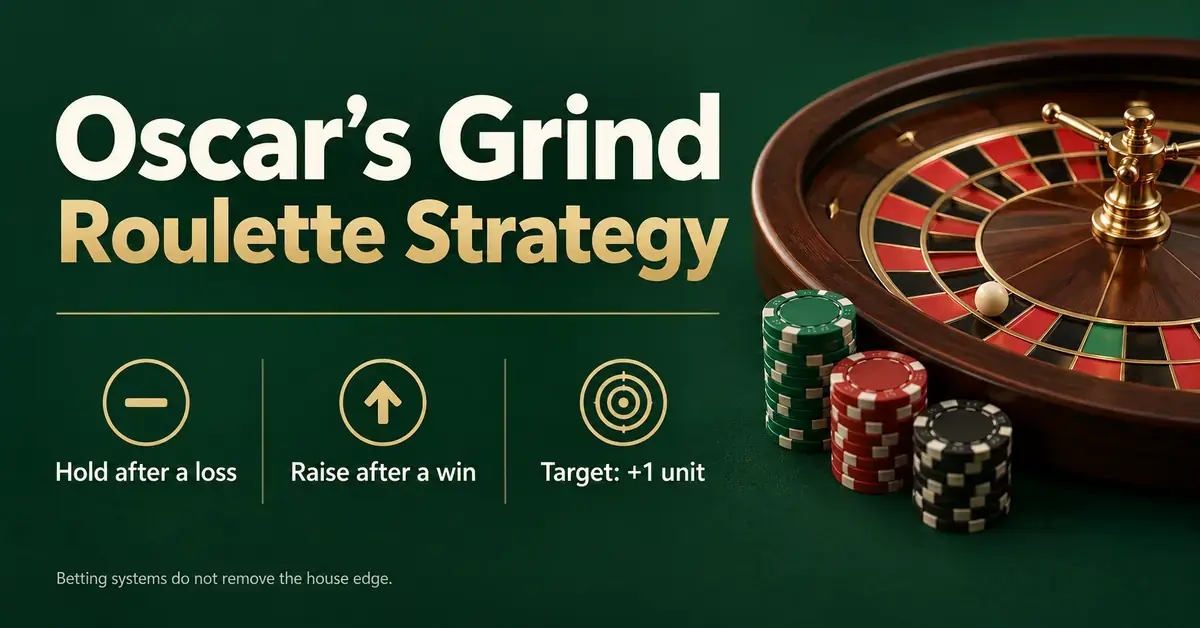
Oscar’s Grind is one of the gentlest betting systems you will come across in roulette. Instead of doubling your stake after a loss, it tells you to raise your bet only after a win, and to grind out small, steady gains until you are one unit ahead. That cautious, slow-and-patient rhythm is exactly why it has a loyal following and why its name includes the word “grind.” This guide explains where the system came from, the precise rules for raising and holding your bet, a full worked example, and the hard math that explains why — like every betting system — it cannot actually beat the house edge.
Key Points
- Positive progression: you raise your bet after a win, not after a loss.
- One-unit goal: each session aims to finish exactly one unit of profit ahead, then resets.
- Four rules: start at one unit, hold after a loss, raise one unit after a win, and never overshoot the +1-unit target.
- Even-money bets only: designed for red/black, odd/even or high/low wagers that pay 1 to 1.
- Documented in 1965 by mathematician Allan N. Wilson and named after a dice player called “Oscar.”
- Cannot beat the house: it reorders your bets but never changes the 2.70% (European) or 5.26% (American) house edge.
What Is the Oscar’s Grind Strategy?
Oscar’s Grind is a positive progression betting system. That phrase simply means you increase your stake after you win, not after you lose. It is the mirror image of “negative progression” systems such as the Martingale system, where you chase losses by doubling up.
The system is built around short cycles called sessions. Each session has a single, modest goal: finish exactly one unit of profit ahead. A “unit” is just your chosen base stake — it might be C$1, C$5 or whatever amount you decide. The moment a session reaches +1 unit, you bank the win, reset, and start the next session from scratch at one unit.
Because the goal is so small and the bet size climbs slowly, a session can last many spins. You are deliberately trying to “grind” your way to a tiny profit rather than swing for a big one. It is designed only for even-money bets — wagers that pay 1 to 1, such as red/black, odd/even or high/low (1–18 / 19–36) — because the whole method assumes a near-coin-flip outcome on each spin.
Where Oscar’s Grind Came From
The system was first documented by the American mathematician Allan N. Wilson in his 1965 book The Casino Gambler’s Guide (Harper & Row). Wilson named it after a low-stakes dice player, known only as “Oscar,” who claimed to make small but consistent profits using the method and kept detailed records to prove it.
Intrigued, Wilson ran extensive mathematical and early computer-simulation analysis on the system. His work showed just how slow the progression really is: using a C$1 unit on an even-money game, a player would typically reach the +1 unit target, and would only run into the casino’s table maximum (then $500) on roughly one series in every 5,000. The catch was that on that rare failing series, the accumulated losses could reach around $13,000 — an early illustration of the system’s hidden tail risk.
You may also see Oscar’s Grind called Hoyle’s Press in older gambling literature, or the Pluscoup Progression in French and German sources. They all describe the same method.
How the Oscar’s Grind Betting Rules Work
The entire system comes down to four rules. They control one thing only: how big your next bet should be.
- Rule 1 — Start at one unit. Every new session begins with a single base-unit bet on an even-money chance.
- Rule 2 — After a loss, keep the bet the same. You never increase your stake to chase a loss. You simply repeat the same bet on the next spin.
- Rule 3 — After a win, raise the bet by one unit. When a win follows a loss (or follows an earlier win within the session), you step your stake up by exactly one unit to speed recovery.
- Rule 4 — Never overshoot the target. You only ever need to finish one unit ahead. If raising the bet would push a winning session past +1 unit, you cut the stake down to the exact amount needed to land on +1 and no more.
Rule 4 is the one beginners forget, and it is what keeps the “grind” disciplined. The aim is a precise +1-unit finish, never a lucky overshoot.
A Worked Example
The table below follows one full session using a one-unit base stake on red. “Profit” is your running total for the session, measured in units. Notice how the bet holds steady through losses, steps up after a win, and is capped so the final win lands on exactly +1 unit.
Sample Session
| Spin | Bet (units) | Result | Profit after (units) |
|---|---|---|---|
| 1 | 1 | Loss | -1 |
| 2 | 1 | Loss | -2 |
| 3 | 1 | Win | -1 |
| 4 | 2 | Loss | -3 |
| 5 | 2 | Win | -1 |
| 6 | 2 | Win | +1 |
The session took six spins to grind out a single unit of profit. On spin 5 the bet would normally have risen to three units (a win following a loss), but because only two more units were needed to reach the target, Rule 4 capped it at two. That final win closed the session at exactly +1 unit, and the next session would begin again at one unit.
Why It Is Called a “Slow Grind”
Two features make Oscar’s Grind slow by design. First, you only raise your stake after wins, so losing runs do not inflate your bets the way they do in doubling systems. Second, each session caps out at a tiny +1-unit goal, so you are constantly resetting rather than letting profits build.
The payoff for that patience is a much flatter bet curve. Where the Martingale can demand enormous stakes after a short losing streak, Oscar’s Grind creeps upward slowly and spends most sessions near the base unit. The trade-off is that a stubborn losing streak early in a session can leave you deep in the red, and climbing back to just +1 unit can then take a long sequence of spins — or run into the table limit before you get there, exactly as Wilson’s simulations showed.
Oscar’s Grind vs Other Roulette Systems
Oscar’s Grind sits in the same family as the other progression systems covered on this site, but its “raise after a win” logic sets it apart from the loss-chasing methods. The comparison below shows where it fits.
- Martingale — a negative progression: double your bet after every loss. Fast recovery but explosive stakes. See the full Martingale guide.
- Fibonacci — a negative progression that steps bets up along the Fibonacci sequence after losses; gentler than Martingale but still loss-driven. See the Fibonacci strategy.
- D’Alembert — raises one unit after a loss and lowers one unit after a win; a slow negative progression that is almost a reverse of Oscar’s Grind. See the D’Alembert system.
- Oscar’s Grind — a positive progression: hold after losses, raise only after wins, aim for +1 unit. The slowest and most conservative of the group.
Whichever system you compare, the underlying math is identical. For the bigger picture on how these methods relate to the odds, see our overview of roulette strategy and odds.
The Math: Why Oscar’s Grind Cannot Beat the House
Every roulette bet carries a built-in house edge, and no betting pattern can remove it. On a single-zero European wheel the edge is 2.70%; on a double-zero American wheel it is 5.26%. An even-money bet wins just under half the time — 18 of 37 pockets (48.6%) in European roulette and 18 of 38 (47.4%) in American roulette — never the clean 50% a coin flip would give. You can compare the two wheels in detail in our guide to European vs American roulette.
Oscar’s Grind only changes the order and size of your bets. It never changes the odds of any individual spin, and each spin is independent of the last. Because every wager loses a small slice to the house edge on average, stringing them together in a clever progression still produces a negative expected return over time. The system can string together many small winning sessions, which feels like success — but the rare long losing session eventually erases those gains, and then some. Mathematically, with a finite bankroll and real table limits, the long-run result is a loss.
Common Mistakes and Misconceptions
- Thinking it is “safe.” Slow does not mean low-risk. A bad early run in a session can bury you far deeper than the single unit you are trying to win.
- Ignoring Rule 4. Forgetting to cap the final bet turns a disciplined grind into an ordinary progression and increases your exposure.
- Using it on inside bets. The system assumes a roughly 50/50 outcome. Straight-up or other high-payout bets break that assumption entirely.
- Believing streaks balance out. The system quietly assumes wins and losses even out. They do not; past spins never influence future ones, as explained in our piece on the gambler’s fallacy.
- Playing without limits. No progression replaces sensible bankroll management and firm stop-loss and win limits.
Who Might Use Oscar’s Grind
Oscar’s Grind tends to appeal to cautious players who enjoy long, low-volatility sessions and the structure of following a clear rule set rather than betting on impulse. Its slow bet growth makes it less likely to hit a table limit quickly than the Martingale, and it keeps most stakes close to the base unit.
It is a poor fit for anyone chasing a big win, anyone with a small bankroll relative to their base unit, or anyone who believes a system can turn roulette into a reliable income. Treated as a way to add rhythm and discipline to recreational play — not as a money-maker — it is one of the more sensible progressions. Treated as a path to profit, it fails for the same reason every system does.
Responsible Gambling and Disclaimer
This article is for information only. It is not betting advice, and no roulette system — including Oscar’s Grind — can overcome the house edge or guarantee a profit. Roulette has a negative expected return over time, so only ever wager money you can afford to lose and treat it as entertainment, not income. The legal gambling age in Canada is 18 or 19 depending on your province or territory.
If gambling is causing harm for you or someone you know, free, confidential help is available 24/7. In Ontario, contact ConnexOntario at 1-866-531-2600. Across Canada, the Responsible Gambling Council lists support services for every province and territory.
Sources
Frequently Asked Questions (FAQ)
Does Oscar’s Grind actually work in roulette?
It works as a structured way to raise and lower your bets, and it can produce many small winning sessions. But it does not overcome the house edge. Over the long run the 2.70% European or 5.26% American edge means the expected result is still a loss.
What is the difference between Oscar’s Grind and the Martingale?
They move in opposite directions. The Martingale is a negative progression that doubles your stake after a loss to recover quickly. Oscar’s Grind is a positive progression that holds your stake after a loss and only raises it after a win, aiming for a slow one-unit gain.
Which bets should I use with Oscar’s Grind?
Only even-money bets that pay 1 to 1, such as red/black, odd/even or high/low. The system assumes a near-coin-flip outcome, so higher-payout inside bets break its logic and should not be used with it.
How many units do I need in my bankroll?
There is no safe fixed number, because a long losing session can run far beyond the single unit you are trying to win. Many players set aside dozens of units and a firm stop-loss, but no bankroll size makes the system profitable in the long run.
Where did the name Oscar’s Grind come from?
It was named after a dice player known as “Oscar,” whose method was documented by mathematician Allan N. Wilson in his 1965 book The Casino Gambler’s Guide. The word “grind” reflects how slowly the system works toward a small profit.
