
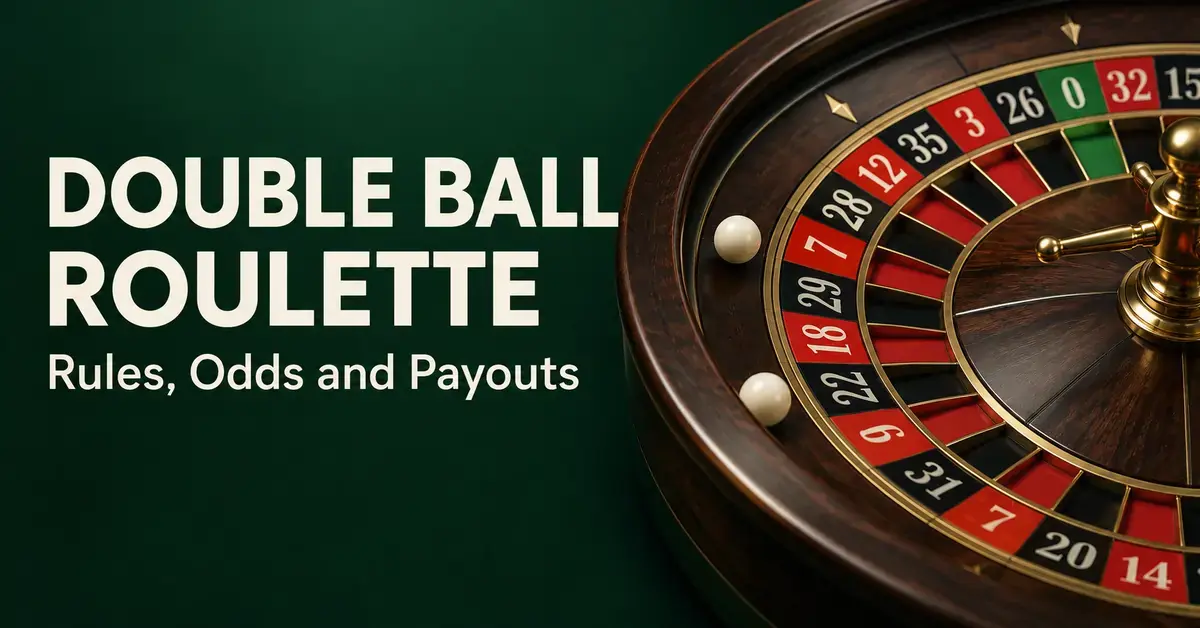
Double ball roulette is a modern twist on the classic game that puts two balls into play on a single spin instead of one. That one change reshapes how bets win, how much they pay and how the house edge stacks up. This guide explains the rules, the payout structure and the real odds so you know exactly what you are betting on before you play, whether you choose a live dealer table or an online random-number version.
Key Facts
- Game type: Roulette variant using two balls per spin
- Wheel: Usually single-zero (37 pockets); some double-zero versions exist
- Balls per spin: 2 (two winning numbers)
- Inside bets: Win if either ball hits; pay double if both hit
- Outside bets: Win only if both balls qualify
- Lowest house edge: About 2.78% (single-number inside bet, single-zero wheel)
- Top payout: 1,300 to 1 (both balls in one number, Evolution live) or 1,200 to 1 (Felt Gaming RNG)
- Formats: Live dealer (Evolution) and online RNG (e.g. Felt Gaming)
What Is Double Ball Roulette?
Double ball roulette is a variant of standard roulette in which two balls are released on every spin, producing two winning numbers instead of one. The wheel and the betting layout are almost identical to the game you already know, so if you can play regular roulette you can play this. Most versions use a single-zero wheel with 37 pockets (numbers 0 to 36), the same wheel used in European (single-zero) roulette compared with the American double-zero wheel, although some casinos offer a double-zero version too.
The format exists in two main forms. The best-known is the live dealer game from Evolution, which uses a patented air-powered launcher to fire two balls onto a real wheel in front of a human croupier. There are also software (RNG) versions, such as the one from Felt Gaming, that simulate two independent balls on screen. The rules are the same; only the delivery differs.
How the Two Balls Are Released
In the live game, both balls sit in a special device on the wheel. At the push of a button the dealer launches the two balls almost simultaneously through separate tubes. Because they leave at the same speed, the second ball trails the first at a fixed distance and never catches or collides with it, so each ball settles into its own pocket independently. If both happen to land in the same number, that is a legitimate and rare result rather than an error.
In an online live dealer roulette stream the process is filmed in a studio, while an RNG version simply generates two independent random results per spin. Either way, you finish with two numbers on the board, and every bet is settled against both of them.
The Rules: How Bets Win
Here is the part that trips up newcomers. Because there are two balls, the winning conditions split into two groups that behave in opposite ways. Understanding this split is the single most important thing about the game, and it is the reason the payouts differ from standard roulette. If you are new to the two categories, our guide to inside bets versus outside bets covers the basics.
Inside bets: either ball can win
Inside bets cover specific numbers or small groups of numbers (straight-up, split, street, corner and line bets). For these, only one of the two balls needs to land on your selection for the bet to win. If both balls land on it, you win twice. Because two balls give you two chances, the payouts are cut to roughly half of standard roulette: a straight-up number pays 17 to 1 when one ball hits, and 34 to 1 when both do, compared with 35 to 1 in normal roulette. For context on how likely a single number is, see the odds of hitting a single number in roulette.
Outside bets: both balls must win
Outside bets cover large groups (red/black, odd/even, high/low, dozens and columns). Here the rule reverses: both balls must satisfy the wager for it to pay. If you bet on red, both balls must land in red numbers; if one lands in red and the other in black, the bet loses. To offset how much harder that is, the payouts are boosted well above normal, so an even-money outside bet pays 3 to 1 instead of 1 to 1. Some tables also add a special “Red & Black” bet that pays 1 to 1 when one ball lands red and the other lands black.
Double Ball Roulette Payouts
The table below shows the standard payout structure for a single-zero double ball game. Inside bets list two figures: what you collect if one ball hits and, in brackets, what you collect if both balls hit your selection. Outside bets pay only when both balls qualify.
Payout Table
| Bet | Numbers covered | Win condition | Payout (one ball / both balls) |
|---|---|---|---|
| Straight-up | 1 | Either ball | 17:1 / 34:1 |
| Split | 2 | Either ball | 8:1 / 16:1 |
| Street | 3 | Either ball | 5:1 / 10:1 |
| Corner | 4 | Either ball | 3:1 / 6:1 |
| Six line | 6 | Either ball | 2:1 / 4:1 |
| Red/Black, Odd/Even, High/Low | 18 | Both balls | 3:1 |
| Dozen / Column | 12 | Both balls | 8:1 |
| Red & Black | — | One ball each colour | 1:1 |
| Double Ball Jackpot | 1 | Both balls, same number | 1,300:1 (Evolution) / 1,200:1 (Felt) |
Payouts can vary slightly between providers. The most notable difference is the top prize: Evolution’s live game advertises payouts of up to 1,300 to 1, while Felt Gaming’s RNG version caps its jackpot at 1,200 to 1.
The Double Ball Jackpot Bet
The signature wager is the double ball jackpot, which wins only if both balls land in the same single number you have chosen. On a single-zero wheel the chance of any two balls sharing one specific pocket is 1 in 1,369 (1/37 multiplied by 1/37), so this is an extremely rare event. In return it pays 1,300 to 1 on Evolution’s live tables and 1,200 to 1 in Felt Gaming’s RNG game.
Despite the eye-catching headline number, this is one of the weaker bets on the table in terms of value, carrying a house edge of roughly 5% or more. The huge payout looks tempting, but the odds of it landing are long enough that it should be treated as a fun long-shot rather than a core strategy.
Odds and House Edge
Double ball roulette does not have a single house edge; it depends heavily on which bets you make and which wheel you play. On a single-zero wheel, the figures are:
- Single-number inside bet: about 2.78%, essentially the same low edge as standard European roulette.
- Two-number (split) inside bet: about 2.99%.
- Even-money outside bets (red/black, odd/even, high/low): about 5.33%, because both balls must win.
- Six-number and jackpot bets: around 5% or higher.
The pattern is clear: inside bets keep the attractive European edge, while outside bets become noticeably more expensive than in regular roulette. On a double-zero (American-style) version everything is worse, with the single-number inside bet edge rising to about 5.33%. This makes the game unusual, because in ordinary roulette outside bets are the low-variance, beginner-friendly choice, whereas here they carry the higher edge. Other formats such as mini roulette shift the odds in their own way, so it always pays to check the numbers for the exact table you sit down at.
Live Dealer vs Online RNG Versions
The live Evolution game is the version most Canadian players will encounter. It runs on a single-zero wheel with a real croupier and the patented two-ball launcher, offers the 1,300 to 1 jackpot, and typically completes a round in around 40 seconds with roughly 18 seconds of betting time. RNG versions, such as Felt Gaming’s, also use a single-zero wheel and identical rules but are played entirely against software, run faster, and cap the jackpot at 1,200 to 1. The core strategy is the same in both: inside bets carry the lowest house edge.
Common Mistakes to Avoid
- Assuming two balls always double your chances. That only helps inside bets. On outside bets, needing both balls to win actually makes them harder than in standard roulette.
- Expecting standard payouts. Inside-bet payouts are roughly halved because you have two chances to hit. The higher outside-bet payouts are there to compensate for a much tougher win condition.
- Chasing the jackpot. The 1 in 1,369 double ball jackpot is a novelty bet with a high house edge, not a reliable way to profit.
- Ignoring the wheel. A double-zero version roughly doubles the house edge on inside bets, so confirm you are on a single-zero table.
Who Should Play Double Ball Roulette?
The game suits players who enjoy extra action and variety and who focus on inside bets, where the house edge stays close to standard European roulette. It is less appealing for players who prefer to grind low-variance even-money bets, since those carry a higher edge here than in the classic game. For Canadians, the live and RNG versions appear on regulated platforms; for example, online roulette is legal in Ontario on provincially licensed sites. As always, no roulette variant can be beaten over the long run, so treat it as entertainment rather than income.
Responsible Gambling
This article is informational only and is not betting advice. Roulette, including double ball roulette, is a game of chance with a built-in house edge, and no bet, system or variant can overcome it over time. You must be of legal age to gamble in your province or territory (18 in Alberta, Manitoba and Quebec; 19 elsewhere in Canada). Set time and money limits before you play, only stake what you can afford to lose, and never chase losses. If gambling is causing you or someone you know harm, free, confidential help is available in Ontario through ConnexOntario, and similar provincial support services operate across the country.
Sources
Frequently Asked Questions (FAQ)
What is double ball roulette?
It is a roulette variant that uses two balls on every spin instead of one, producing two winning numbers. The wheel and betting layout are almost the same as standard roulette, but the payouts and winning conditions are adjusted to account for the second ball.
Can both balls land on the same number?
Yes. Because the two balls travel independently, they can both settle in the same pocket. This is what the double ball jackpot bet is based on, and on a single-zero wheel the chance of two balls sharing one specific number is 1 in 1,369.
Do outside bets pay more in double ball roulette?
They pay more per win, but they are also harder to win. Both balls must satisfy an outside bet for it to pay, so an even-money bet such as red or black pays 3 to 1 instead of 1 to 1. The higher payout compensates for the tougher condition, and the house edge on these bets is actually higher than in standard roulette.
What is the house edge in double ball roulette?
It depends on the bet and the wheel. On a single-zero wheel a single-number inside bet has a house edge of about 2.78%, close to standard European roulette, while even-money outside bets sit around 5.33%. A double-zero version raises the edge on inside bets to roughly 5.33%.
Is double ball roulette available to Canadian players?
Yes. Evolution’s live double ball roulette and RNG versions appear on regulated online casino platforms, including provincially licensed sites in Ontario. Availability and the minimum legal age vary by province, so check the rules where you live before playing.
