
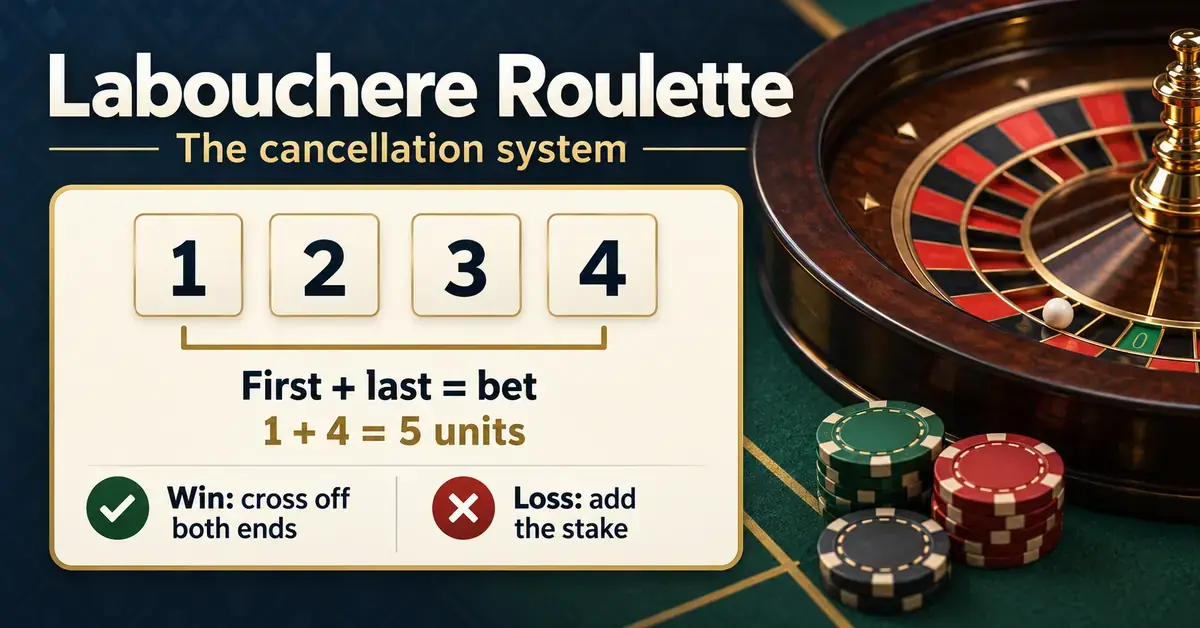
The Labouchere is one of the best-known roulette betting systems, and also one of the most misunderstood. Often called the cancellation system or the split Martingale, it works from a short list of numbers you write down before you play. You bet on even-money outcomes, cross numbers off when you win and add numbers when you lose, aiming to clear the whole list for a set profit. This guide explains exactly how the cancellation system works, walks through a full example, covers the reverse version, and looks honestly at what the maths says it can and cannot do.
Key Points
- The Labouchere is a negative-progression roulette system also called the cancellation system or split Martingale, used on even-money bets.
- You choose a target profit and write a line of numbers that add up to it — a common starting line is 1-2-3-4 (target 10 units).
- Each bet equals the first plus the last number on the line; cross both off after a win, add your losing stake to the end after a loss.
- Clearing the whole line wins your target. You remove two numbers per win but add only one per loss, so the line shrinks if you win often enough.
- It does not change the house edge (2.70% European, 5.26% American), and losing streaks push stakes up fast toward your bankroll or the table limit.
What is the Labouchere strategy?
The Labouchere is a negative progression betting system, meaning you increase your stake after a loss. It is named after Henry Labouchere, a 19th-century British politician, journalist and keen roulette player who is credited with popularising it. Because it splits the job of recovering losses across several winning bets rather than one, it is sometimes called the split Martingale.
Like most systems, it is designed for even-money bets — wagers that pay 1:1, such as red/black, odd/even or high/low (1-18 / 19-36). If you want a refresher on how these wagers behave, see our guide to even-money bets in roulette. The core idea is simple: you decide how much profit you want, write down a line of numbers that add up to that target, and use the line to tell you how much to bet on each spin.
The distinctive feature is the “cancellation” mechanic. You remove two numbers from your line for every win but add only one number for every loss. Clear the whole line and you have won your target amount — at least in theory.
How the cancellation system works
The Labouchere runs on four steps. Once you understand them, the whole system follows automatically.
Step 1: Set your line
Decide on a target profit in units, then write a line of positive numbers that add up to it. A common starting line is 1-2-3-4, which sums to 10 units. The individual numbers do not have to be equal or in order — 2-2-2-2-2 or 1-1-1-1-1-1-1-1-1-1 would also target 10 units. Smaller numbers mean smaller, slower swings; larger numbers mean bigger bets.
Step 2: Bet the two ends
Your stake for each spin is the sum of the first and last numbers on the line. With the line 1-2-3-4, your first bet is 1 + 4 = 5 units. If only one number is left, you simply bet that number.
Step 3: Cross off after a win
If the bet wins, cross off both the first and last numbers. The line 1-2-3-4 becomes 2-3. Your next stake is now 2 + 3 = 5 units.
Step 4: Add the stake after a loss
If the bet loses, add the amount you just staked to the end of the line. From the line 2-3, a losing 5-unit bet makes the line 2-3-5, and your next stake becomes 2 + 5 = 7 units.
You keep going until the line is completely crossed out — meaning you have banked your target profit — or until you run out of money or hit the table’s maximum bet. Because each win erases two numbers while each loss adds only one, the line shrinks over time as long as you win at least roughly a third of your bets.
A worked example
Say you start with the line 1-2-3-4, targeting a 10-unit profit. Here is how one session might play out:
| Spin | Line | Stake (first + last) | Result | Running profit |
|---|---|---|---|---|
| 1 | 1-2-3-4 | 5 (1 + 4) | Win | +5 |
| 2 | 2-3 | 5 (2 + 3) | Loss | 0 |
| 3 | 2-3-5 | 7 (2 + 5) | Win | +7 |
| 4 | 3 | 3 (single number) | Win | +10 |
After spin 4 the line is empty, so the session ends with exactly the 10-unit profit you set as your target — the same as the sum of your original line. Note that this happened with two wins and one loss out of three deciding bets, which is the appeal of the system: you can lose several bets and still finish ahead, provided you win often enough to keep clearing the line.
The reverse Labouchere
The reverse Labouchere flips the rules to make it a positive progression, where you raise your stake after wins instead of losses. You still bet the sum of the first and last numbers, but now you add your stake to the line after a win and cross off the two end numbers after a loss.
The goal changes too. Instead of grinding out a fixed profit, you try to ride a winning streak, and you usually set a cap on how large the line can grow before you stop and bank the profit. The original line sum becomes roughly your maximum loss, while your potential upside depends on catching a run of wins. It is a milder, streak-chasing alternative — but, like every roulette system, it does not change your long-term odds.
Why the Labouchere cannot beat the house edge
The Labouchere is clever bankroll bookkeeping, not a way to win. No betting pattern can change the fact that every spin is independent and each even-money bet carries a built-in house edge — the casino’s mathematical advantage. On a single-zero European wheel the edge on even-money bets is 2.70%; on a double-zero American wheel it jumps to 5.26%. For why that gap matters, see European vs American roulette.
On a European wheel an even-money bet wins 18 times out of 37, or about 48.6% of the time — just under the 50% you would need to break even. The zero (and the double zero on American wheels) is exactly where the house edge comes from. The Labouchere does nothing to touch that number; it only reshuffles when you bet more and when you bet less.
The real danger is the same one that sinks every negative progression: a losing run makes your bets grow quickly. Each loss adds a number to your line, and the end numbers keep climbing, so a bad streak can push your required stake past your bankroll or the table maximum before the line clears. When that happens, you are locked out of finishing the line and the accumulated losses are large. Sensible roulette bankroll management — firm loss limits and modest starting numbers — is the only thing that keeps the swings in check.
Comparison
| System | Progression | How stakes change | Recovery style |
|---|---|---|---|
| Labouchere (cancellation) | Negative | Bet the sum of the two end numbers; add one number per loss | Spreads recovery over several wins |
| Martingale | Negative | Double the bet after every loss | Recovers all losses with one win |
| D’Alembert | Negative | Raise the bet by one unit after a loss, lower it after a win | Slow, even recovery |
| Fibonacci | Negative | Move along the Fibonacci sequence after losses | Recovers over two consecutive wins |
Compared with the Martingale roulette strategy, which doubles your bet after every loss and tries to recover everything in one hit, the Labouchere spreads recovery across several wins, so stakes usually rise more gently. But “more gently” is not “safely” — the escalation is slower, not absent.
Common mistakes and risks
- Starting with big numbers. A line like 5-10-15-20 targets 50 units but exposes you to punishing stakes after only a few losses. Beginners should keep the numbers small.
- Ignoring the table limit. Every table has a maximum bet. A long losing streak can push your required stake above it, leaving the line unfinishable.
- Believing the system “guarantees” a win. It does not. It converts many small wins and the occasional catastrophic losing run into a strategy that usually shows a session profit — while the rare bad session can wipe out many good ones.
- Chasing losses. Rewriting or extending the line to “get it back” is exactly how small planned losses turn into large ones.
- Confusing it with an edge. Believing a system is “due” to win is the gambler’s fallacy — past spins never change the next result.
Who the Labouchere suits
The Labouchere appeals to players who like structure and record-keeping, and who enjoy a system with a clear target and a defined stopping point. Because you write everything down, it forces a degree of discipline that random betting lacks. It suits a player with a fixed, modest bankroll who treats the whole exercise as entertainment and accepts that the numbers still favour the house.
It is a poor fit for anyone hoping to turn roulette into reliable income, anyone tempted to chase losses, or anyone playing on an American double-zero wheel where the edge is nearly twice as high. If you want frequent small wins from broad table coverage instead of a written line, the James Bond roulette strategy takes a different approach — though it, too, cannot beat the house edge.
A note on responsible gambling
Roulette is a game of chance with a permanent house edge, and no betting system — including the Labouchere — can change your long-term odds or turn the game into a source of income. Bets should be made only with money you can afford to lose, and any wins should be treated as luck rather than the result of a winning method. In Canada, free and confidential support is available around the clock from the Responsible Gambling Council and, in Ontario, from ConnexOntario (1-866-531-2600). You must be of legal gambling age in your province or territory to play.
Sources
Frequently asked questions (FAQ)
Does the Labouchere roulette strategy actually work?
It works as a staking plan, not as a way to win money over time. Clearing your line delivers your target profit, and you can lose a fair share of bets and still finish ahead in a session. But it does not change the house edge, and a long losing streak can push your stakes beyond your bankroll or the table limit before the line clears, producing a large loss that outweighs many small wins.
What is the difference between the Labouchere and the Martingale?
Both are negative progressions that raise stakes after losses. The Martingale doubles your bet each time and aims to recover all losses with a single win, so stakes escalate very fast. The Labouchere spreads recovery across several wins by crossing two numbers off the line per win and adding one per loss, so bets usually grow more slowly — but still grow.
What is the reverse Labouchere?
It is the mirror image: a positive progression where you add your stake to the line after a win and cross off the two end numbers after a loss. The aim is to profit from a winning streak while your maximum loss is capped near the original line total. It, too, leaves the house edge unchanged.
What numbers should I use in my Labouchere line?
Any positive numbers that add up to the profit you want. Beginners are usually advised to keep them small and even, such as 1-2-3-4, because larger numbers create bigger bets and faster escalation after losses. The sum of your line equals the profit you make if you clear it.
Can the Labouchere be used on American roulette?
Yes, but it is a worse deal. American wheels have both a zero and a double zero, raising the even-money house edge to about 5.26% versus 2.70% on a single-zero European wheel. That higher edge makes losing streaks more likely and more costly, so a European or French wheel is the better choice if you use the system at all.
