
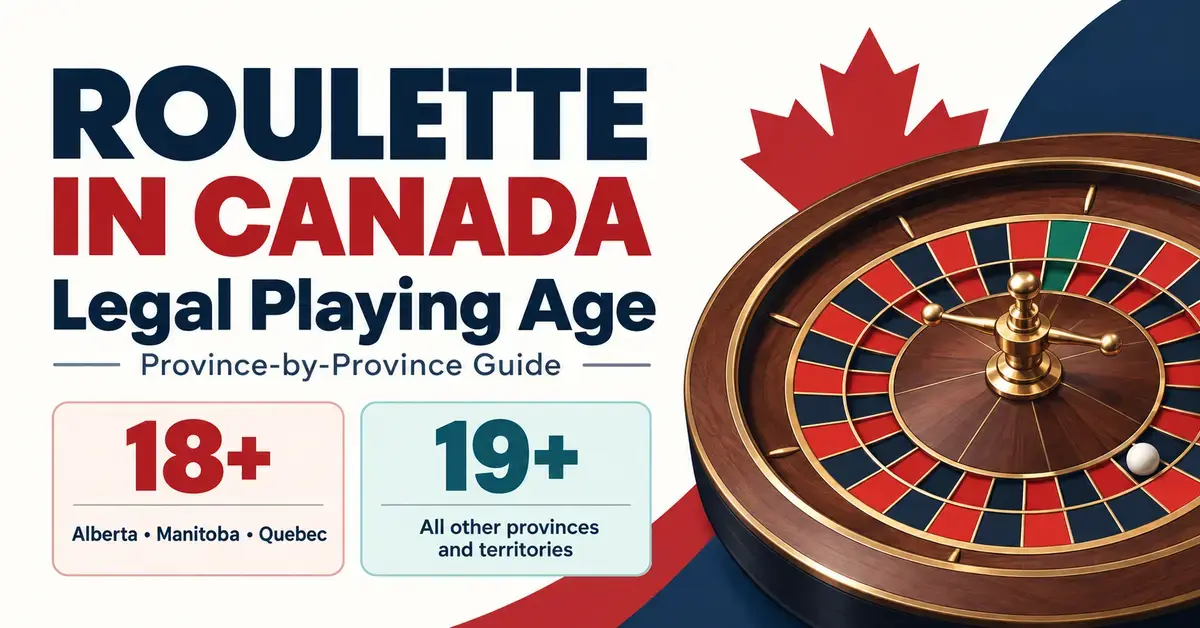
There is no single national gambling age in Canada. The legal age to play roulette — at a physical wheel in a casino or on a licensed online site — is set by each province and territory, which means the answer changes depending on where you are standing when you place a bet. In most of the country the minimum age is 19, but three provinces allow play at 18. This guide breaks the rules down province by province, explains why your location (not your home address) decides which age applies, and shows how casinos check it.
Key Points
- No single national age: each province and territory sets its own minimum gambling age.
- Age 18: Alberta, Manitoba and Quebec.
- Age 19: British Columbia, Saskatchewan, Ontario, New Brunswick, Nova Scotia, Prince Edward Island, Newfoundland and Labrador, plus Yukon, the Northwest Territories and Nunavut.
- Location rule: the age is set by where you physically play, not where you live.
- Same online: the age applies equally to land-based, online and live-dealer roulette, with ID and age verification required to play for real money.
The two legal ages: 18 or 19
Gambling in Canada is regulated at the provincial and territorial level, not federally. Under the Criminal Code, provinces and territories are responsible for licensing and running lawful gambling within their borders, so each one sets its own minimum age. In practice there are only two numbers to remember:
- 18 years old — Alberta, Manitoba and Quebec.
- 19 years old — every other province, plus all three territories.
This age applies to all forms of casino-style gambling covered by the province, including roulette, slot machines, blackjack, poker, sports betting and, in most places, online play. (Some provinces set a lower age of 18 for simple lottery tickets, but the casino-game age — the one that matters for roulette — follows the numbers above.)
Legal roulette age by province and territory
The table below lists the minimum age to play roulette in each Canadian jurisdiction along with the main body that runs or regulates gambling there. “Regulator/operator” refers to the government agency or Crown corporation responsible for legal gaming in that province.
Age by Province
| Province / Territory | Minimum age | Main regulator / operator |
|---|---|---|
| Alberta | 18 | Alberta Gaming, Liquor and Cannabis (AGLC) |
| Manitoba | 18 | Liquor, Gaming and Cannabis Authority / Manitoba Liquor & Lotteries |
| Quebec | 18 | Loto-Québec |
| British Columbia | 19 | British Columbia Lottery Corporation (BCLC / PlayNow.com) |
| Saskatchewan | 19 | Saskatchewan Liquor and Gaming Authority (SLGA) |
| Ontario | 19 | Alcohol and Gaming Commission of Ontario (AGCO) / iGaming Ontario |
| New Brunswick | 19 | Atlantic Lottery Corporation |
| Nova Scotia | 19 | Atlantic Lottery Corporation |
| Prince Edward Island | 19 | Atlantic Lottery Corporation |
| Newfoundland and Labrador | 19 | Atlantic Lottery Corporation |
| Yukon | 19 | Government of Yukon |
| Northwest Territories | 19 | Government of the Northwest Territories |
| Nunavut | 19 | Government of Nunavut |
Provinces where the age is 18
Only three provinces let adults play roulette from 18:
- Alberta — gaming is overseen by Alberta Gaming, Liquor and Cannabis (AGLC), which sets the minimum age at 18 for casinos, video lottery terminals and the province’s online site.
- Manitoba — regulated by the Liquor, Gaming and Cannabis Authority of Manitoba and run by Manitoba Liquor & Lotteries; the minimum age is 18.
- Quebec — gambling is run by the Crown corporation Loto-Québec, and 18 is the minimum age at its casinos and on its online platform.
Provinces and territories where the age is 19
Everywhere else, you must be 19 to play roulette:
- British Columbia — the British Columbia Lottery Corporation (BCLC) runs land-based casinos and the province’s only legal online site, PlayNow.com; the age is 19.
- Saskatchewan — regulated by the Saskatchewan Liquor and Gaming Authority (SLGA); the age is 19.
- Ontario — land-based and regulated online gaming are overseen by the Alcohol and Gaming Commission of Ontario (AGCO) and iGaming Ontario; the age is 19.
- New Brunswick, Nova Scotia, Prince Edward Island and Newfoundland and Labrador — these four Atlantic provinces all set the age at 19, with gaming products supplied through the Atlantic Lottery Corporation.
- Yukon, Northwest Territories and Nunavut — all three territories set the minimum age at 19.
Why your location decides the age, not your home address
The rule that surprises many players: the minimum age is based on where you are physically located when you gamble, not where you live. If you are a 19-year-old from Ontario visiting a casino in Alberta, the Alberta age of 18 applies and you can play. But an 18-year-old from Alberta cannot walk into a British Columbia casino, because BC’s age is 19 — even though they can legally gamble back home.
The same principle applies online. Licensed Canadian gambling sites use your account details and, in many cases, geolocation to confirm which province you are playing from, and they apply that province’s minimum age. Being of legal age in your home province does not let you play from a stricter province.
Land-based roulette versus online roulette
The minimum age is the same whether you play a physical wheel or a digital one, but the checks differ:
- In a casino — staff can ask for government-issued photo ID at the door or at the table. Casinos routinely card anyone who looks under a set age, and entry is refused without valid proof.
- Online — you cannot open or fund an account until the operator verifies your identity and age. This is part of “Know Your Customer” (KYC) checks, the identity verification licensed operators are legally required to complete before you can bet real money.
Live-dealer roulette — a real croupier streamed to your device — counts as online gambling and is subject to the same age and verification rules as any other online game. If you are new to how the wheel and bets actually work, our roulette guide homepage is a good starting point before you play for money.
How age verification works online
Regulated Canadian sites confirm your age during sign-up, typically by asking for:
- Your date of birth and full legal name.
- A government-issued ID such as a driver’s licence or passport.
- Proof of address, and sometimes an electronic identity check against official records.
Until these checks pass, you generally cannot deposit or withdraw. Providing false information about your age is a breach of the operator’s terms and can lead to a closed account and forfeited funds. These controls also help operators meet anti-money-laundering obligations and keep minors out.
Common misconceptions
- “The gambling age in Canada is 18.” False for most of the country. It is 18 in only three provinces; 19 applies to the other seven provinces and all territories.
- “An offshore site showing ’18+’ means I can play at 18.” The “18+” badge seen on many international sites does not override your provincial law. If you are physically in a 19 province, 19 is the legal age.
- “My home province’s age travels with me.” It does not. The age of the province you are physically in when you play is what counts.
- “Free-play or demo roulette has no age rule.” Age restrictions still apply to real-money play, and demo modes do not change your odds or improve your chances of winning.
Who regulates roulette in each province
Because there is no single national gambling regulator, the body that licenses and enforces the rules — including the minimum age — is provincial. Examples include AGLC in Alberta, Loto-Québec in Quebec, BCLC in British Columbia, SLGA in Saskatchewan, and the AGCO with iGaming Ontario in Ontario. These agencies also set responsible-gambling requirements, run self-exclusion programs and, for online play, decide which operators may legally offer games to residents of that province.
Disclaimer
This article is for general information only and is not legal advice. Gambling laws and minimum ages can change; confirm the current rules with your provincial regulator before you play. Gambling involves risk, and no strategy, system or demo mode can guarantee a win or improve the built-in house edge of roulette. You must meet your jurisdiction’s minimum age to gamble. If gambling is affecting you or someone you know, free, confidential help is available across Canada — including the Responsible Gambling Council’s provincial help lines and, in Ontario, ConnexOntario at 1-866-531-2600. Please play responsibly and within your limits.
Sources
- Alcohol and Gaming Commission of Ontario — Eligibility (minimum age)
- Province of British Columbia — Gambling in B.C.
- British Columbia Lottery Corporation — eGaming FAQ
- Alberta Gaming, Liquor and Cannabis (AGLC)
- Legal Line — What is the legal age to gamble in a casino?
- Responsible Gambling Council — Help for Canadians
Frequently Asked Questions (FAQ)
What is the legal age to play roulette in Canada?
It depends on the province or territory. The minimum age is 18 in Alberta, Manitoba and Quebec, and 19 in every other province and in all three territories.
Is the gambling age based on where I live or where I am?
Where you are physically located when you play. If you travel to a province with a different minimum age, that province’s age applies, regardless of your home address.
Is the online roulette age the same as in a casino?
Yes. The minimum age is identical for land-based and online play, including live-dealer roulette. Online operators verify your age and identity before you can deposit or bet real money.
Why do some gambling sites show “18+” if the age is 19 where I live?
A generic “18+” label, often from international sites, does not override provincial law. If you are physically in a province where the age is 19, then 19 is the legal minimum for you.
What happens if I gamble under the legal age?
You can be refused entry or service, and online accounts opened with false age details can be closed with funds forfeited. Meeting the minimum age is a firm legal requirement, not just a site policy.
