
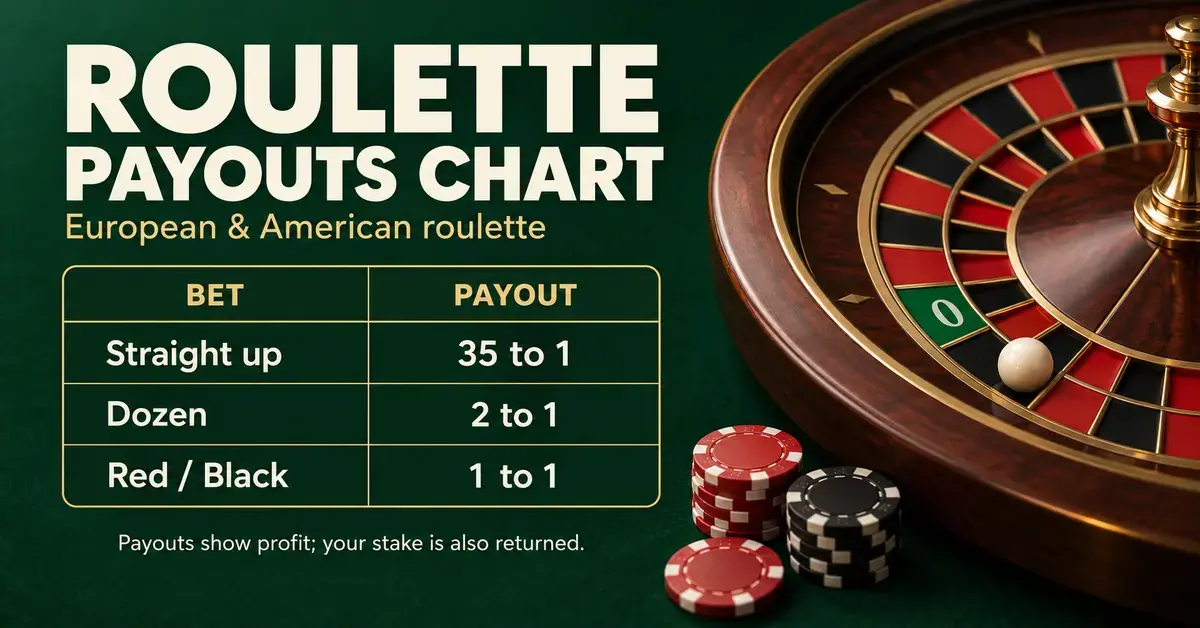
A roulette payouts chart is the single most useful reference a player can have at the table. It tells you, at a glance, how much each bet pays if it wins, how many numbers that bet covers, and how often it is likely to land. Once you understand the pattern behind the numbers, you can read any roulette table in seconds and know exactly what you stand to win. This guide sets out the full chart for both the European (single-zero) and American (double-zero) wheels, and explains the simple math that ties every payout together.
How roulette payouts are calculated
Every payout in roulette is built on one assumption: that the wheel has 36 numbers. The game pays you as if the zero (and, on American tables, the double zero) did not exist. That is where the casino’s advantage, known as the house edge, comes from.
The rule is easy to remember. A payout ratio is written as “X to 1”, meaning you win X units of profit for every 1 unit you stake, and you also get your original stake back. To work out the ratio for any inside bet, divide 36 by the number of pockets your bet covers, then subtract 1:
- Cover 1 number: 36 ÷ 1 = 36, minus 1 = 35 to 1.
- Cover 2 numbers: 36 ÷ 2 = 18, minus 1 = 17 to 1.
- Cover 4 numbers: 36 ÷ 4 = 9, minus 1 = 8 to 1.
- Cover 12 numbers: 36 ÷ 12 = 3, minus 1 = 2 to 1.
The catch is that the wheel actually has 37 pockets in the European game and 38 in the American game. Because you are paid on a 36-number basis but the ball can land in an extra pocket or two, the casino keeps a fixed slice of every bet over time. That slice is 2.70% on a European wheel and 5.26% on an American wheel, and it applies to almost every standard bet.
Key Points
- Every roulette payout is calculated as if the wheel had 36 numbers, which is where the house edge comes from.
- Payout ratios are identical on European and American wheels; only the win odds differ.
- Inside bets pay more but win rarely; outside bets pay less but win often.
- The house edge is 2.70% on European (single-zero) wheels and 5.26% on American (double-zero) wheels.
- The American-only five-number bet pays 6:1 but carries a 7.89% edge — the worst bet on the table.
- La Partage on French tables cuts the even-money edge to 1.35%.
Inside bets and what they pay
Inside bets are placed on individual numbers or small groups of numbers printed inside the main grid. They cover fewer numbers, so they pay more but win less often. If you want a full walk-through of where each chip sits on the felt, see our guide to the roulette table layout.
- Straight up (1 number): pays 35 to 1. The biggest single payout on the table and the rarest win. For the exact math behind it, read our piece on the odds of hitting a single number.
- Split (2 numbers): a chip on the line between two adjacent numbers pays 17 to 1.
- Street (3 numbers): a chip at the end of a row of three pays 11 to 1.
- Corner, also called a square (4 numbers): a chip on the shared corner of four numbers pays 8 to 1.
- Six line, also called a double street (6 numbers): covers two adjacent rows of three and pays 5 to 1.
The American wheel adds one extra inside wager, the five-number bet, which is covered in its own section below.
Outside bets and what they pay
Outside bets sit in the boxes around the number grid. They cover large blocks of numbers, so they win far more often but pay much less. A deeper comparison of the two families is in our guide to inside bets vs outside bets.
- Column (12 numbers): covers one of the three vertical columns and pays 2 to 1. The zero (and double zero) are not part of any column.
- Dozen (12 numbers): covers 1–12, 13–24 or 25–36 and pays 2 to 1.
- Red or Black (18 numbers): pays 1 to 1, known as even money.
- Odd or Even (18 numbers): pays 1 to 1.
- High or Low, 1–18 or 19–36 (18 numbers): pays 1 to 1.
The three even-money bets are the most popular starting point for new players because they win close to half the time. We cover them in detail, including how French rules soften the loss, in our guide to even-money bets in roulette.
The full roulette payouts chart
The chart below brings every standard bet together in one place. “Win chance” is the probability the bet lands on a single spin: it is simply the numbers covered divided by the total pockets on the wheel (37 in Europe, 38 in America). Notice that the payout column is identical for both wheels — only the odds of winning change.
Payouts Chart
| Bet | Numbers covered | Payout | European win chance | American win chance |
|---|---|---|---|---|
| Straight up | 1 | 35:1 | 2.70% | 2.63% |
| Split | 2 | 17:1 | 5.41% | 5.26% |
| Street | 3 | 11:1 | 8.11% | 7.89% |
| Corner (square) | 4 | 8:1 | 10.81% | 10.53% |
| Six line (double street) | 6 | 5:1 | 16.22% | 15.79% |
| Five-number (American only) | 5 | 6:1 | — | 13.16% |
| Column | 12 | 2:1 | 32.43% | 31.58% |
| Dozen | 12 | 2:1 | 32.43% | 31.58% |
| Red / Black | 18 | 1:1 | 48.65% | 47.37% |
| Odd / Even | 18 | 1:1 | 48.65% | 47.37% |
| High / Low | 18 | 1:1 | 48.65% | 47.37% |
The American five-number bet: the one to avoid
The American double-zero wheel offers one extra wager that does not exist in Europe: the five-number bet, also called the basket or top-line bet. A single chip covers 0, 00, 1, 2 and 3, and it pays 6 to 1.
On paper that looks reasonable, but the math is unkind. Covering 5 of 38 pockets and paying only 6 to 1 gives it a house edge of about 7.89% — noticeably worse than the 5.26% that every other American bet carries. It is widely regarded as the single worst bet on the roulette table, and most players skip it entirely.
Same payouts, different odds: European vs American
This is the most important thing the chart reveals. A straight-up number pays 35 to 1 on both wheels, but your chance of winning it is 2.70% in Europe and only 2.63% in America, because the American wheel has an extra pocket (the 00). The payout stays the same while your odds get worse, which is why the American house edge is almost double the European one.
In practical terms, if you have a choice, the single-zero wheel is always the better game. Our full breakdown of the two formats, including how the extra pocket changes your long-run results, is in European vs American roulette.
How French rules change even-money payouts
Some single-zero tables, usually labelled French roulette, add a rule that improves even-money bets specifically. Under La Partage, if the ball lands on zero, you lose only half of an even-money stake instead of all of it. The related En Prison rule locks the stake for one more spin instead. Either rule cuts the house edge on red/black, odd/even and high/low bets from 2.70% down to just 1.35% — the best odds available anywhere in roulette. These rules do not change the printed payouts; they change what happens when zero hits. Full details are in our guide to French roulette rules.
Reading the chart: turning payouts into real money
A payout ratio only becomes useful when you attach a stake to it. Because the ratio is profit “to 1”, a winning bet returns your stake plus the profit shown. Here is what a $10 bet returns on each bet type:
| Bet | Payout | Profit on $10 | Total returned |
|---|---|---|---|
| Straight up | 35:1 | $350 | $360 |
| Split | 17:1 | $170 | $180 |
| Street | 11:1 | $110 | $120 |
| Corner | 8:1 | $80 | $90 |
| Six line | 5:1 | $50 | $60 |
| Column / Dozen | 2:1 | $20 | $30 |
| Red/Black, Odd/Even, High/Low | 1:1 | $10 | $20 |
Common misconceptions about payouts
- “A bigger payout means a better bet.” It does not. Every standard bet carries the same house edge on a given wheel, so a 35:1 straight-up bet is no more profitable in the long run than a 1:1 even-money bet. The payout simply reflects how rarely the bet wins.
- “Payouts include my stake.” They do not. “35 to 1” means $35 profit on top of the $1 you get back, for $36 total — not $35 total.
- “Betting more numbers guarantees a profit.” Covering more of the layout raises your chance of a win on any spin, but the house edge is unchanged and overlapping bets can cancel each other out. No combination of bets removes the edge.
- “Past spins change the odds.” Each spin is independent. A colour that has not appeared for ten spins is no more likely to appear next. Managing your money matters far more than chasing patterns; see our guide to roulette bankroll management.
Which bets suit which players
The chart makes the trade-off clear. If you enjoy frequent, smaller wins and longer sessions, the even-money and 2-to-1 outside bets keep you in the game longest. If you are chasing a large one-off payout and accept that most spins will lose, the inside bets deliver the biggest returns. Neither approach beats the house edge, so the best bet is always the one that matches the entertainment you want for the money you have set aside.
Responsible gambling
Roulette is a game of chance with a built-in house edge, and no payout chart, bet selection or betting system can overcome it. The information here is for general education, not betting advice, and it does not improve your chances of winning. In Canada, the minimum gambling age is 19 in most provinces and 18 in Alberta, Manitoba and Quebec. Only ever wager money you can afford to lose, and set time and spending limits before you play. If gambling stops being fun or feels hard to control, free, confidential help is available through the Responsible Gambling Council and, in Ontario, through ConnexOntario at 1-866-531-2600.
Sources
Frequently asked questions (FAQ)
What is the highest paying bet in roulette?
The straight-up bet on a single number pays the most at 35 to 1, meaning a winning $10 bet returns $360 in total. It is also the least likely bet to win, landing about 2.70% of the time on a European wheel and 2.63% on an American wheel.
Do roulette payouts include my original stake?
No. Payouts are quoted as profit “to 1”. A 35 to 1 win pays you $35 in profit for each $1 staked, plus you receive your original $1 back. So a winning $1 straight-up bet gives you $36 in total, not $35.
Are the payouts the same on European and American roulette?
Yes, the payout ratios are identical on both wheels. What changes is your chance of winning. The American wheel has an extra double-zero pocket, so every bet wins slightly less often, which raises the house edge from 2.70% to 5.26%.
Why does a straight-up bet pay 35 to 1 and not 36 to 1?
Payouts are calculated as if the wheel had exactly 36 numbers, but a real wheel has 37 or 38 pockets because of the zero and double zero. Paying 35 to 1 instead of the “fair” 36 to 1 is precisely how the casino keeps its house edge.
Which roulette bet has the best odds?
The even-money bets — red/black, odd/even and high/low — win close to half the time. On a French single-zero table with the La Partage rule, their house edge drops to just 1.35%, the lowest of any bet in roulette.
