
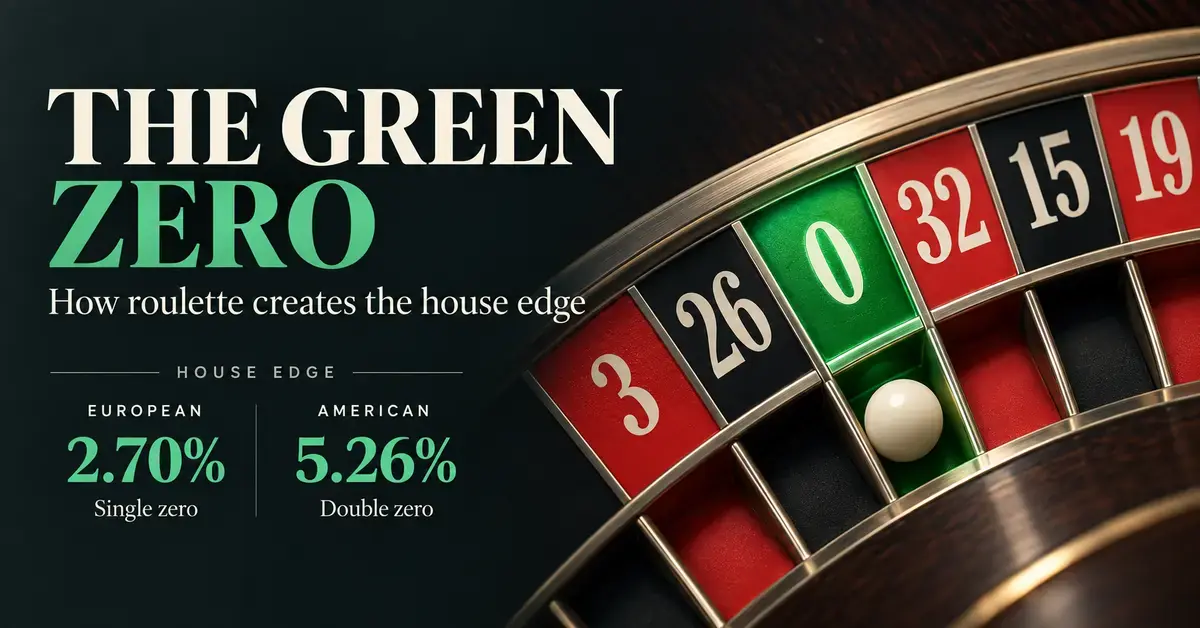
Look at any roulette wheel and one pocket stands out: a single green slot marked 0 (with a second green 00 on American wheels), sitting among 36 alternating red and black numbers. That green pocket is not decoration and it is not random. It is the single most important feature on the wheel, because it is exactly where the casino’s built-in profit margin — the house edge — comes from. This guide explains what the green zero is, why it is coloured green, where it came from, and the simple maths that turns one small pocket into a permanent advantage for the house.
Key Points
- The green zero (0) is the only pocket on the wheel that is neither red nor black; American wheels add a second green pocket, the 00.
- It is coloured green so it cannot be confused with a red or black number when bets are settled.
- A European wheel has 37 pockets and a house edge of about 2.70%; an American wheel has 38 pockets and a 5.26% edge.
- The edge exists because payouts are priced as if there were only 36 pockets, while the green zero(s) add one or two more.
- All even-money bets (red/black, odd/even, high/low) lose when the ball lands on a green zero.
- La partage and en prison rules on single-zero tables can cut the even-money edge to about 1.35%.
What is the green zero?
A standard roulette wheel is divided into numbered pockets. The numbers 1 to 36 are split evenly into 18 red and 18 black. The zero — and, on American wheels, the double zero (00) — belongs to neither colour, so it is coloured green to keep it visually separate.
- European (single-zero) wheel: 37 pockets in total — the numbers 1 to 36 plus a single green 0.
- American (double-zero) wheel: 38 pockets — the same 1 to 36 plus two green pockets, 0 and 00.
- Triple-zero wheel: a newer 39-pocket variant with 0, 00 and 000, all green.
Everything about how a bet pays out depends on that pocket count. The more green pockets a wheel has, the worse the odds are for the player.
Why is the zero coloured green?
The colour choice is a practical one. On the earliest wheels used in Paris in the late 1700s, the single zero was coloured red and the double zero was black — the same two colours used for the ordinary numbers. That made it far too easy to confuse a zero with a red or black number when settling bets. During the 1800s, casinos switched the zero pockets to green so a player and dealer could tell instantly whether the ball had landed on a number or on a zero. Green had no other meaning on the layout, so it became the universal marker for the house pockets and has stayed that way ever since.
Where the green zero came from: the Blanc brothers
Early wheels carried both a 0 and a 00. In 1843, in the German spa town of Bad Homburg, French brothers François and Louis Blanc introduced a wheel with only a single zero. It was a competitive move: by removing one green pocket, they roughly halved the house edge and drew players away from rival casinos still running double-zero wheels. That single-zero design became known as French or European roulette and remains the standard across Europe and most of the world today. When roulette later crossed the Atlantic, American casinos kept — and in some cases restored — the second zero, which is why the double-zero wheel is now called American roulette. If you want the full breakdown of how these two wheels differ, see our guide to European vs American roulette.
How the green zero creates the house edge
The house edge comes from a deliberate gap between the true odds of a bet and the payout the casino offers. The green zero is what opens that gap.
The payout maths
A straight-up bet on a single number pays 35 to 1. That payout would be perfectly fair on a wheel with exactly 36 pockets: over 36 spins you would expect to win once (collecting 35 units plus your own stake back) and lose 35 times, breaking even in the long run.
But a real wheel does not have 36 pockets. A European wheel has 37, and an American wheel has 38 — because of the green zero(s). The payout is still calculated as if the extra pocket were not there. That mismatch is the entire house edge:
- European wheel: your chance of winning a single-number bet is 1 in 37, but you are paid as if it were 1 in 36. The shortfall works out to a house edge of about 2.70% (1 ÷ 37).
- American wheel: with two green pockets your chance is 1 in 38, paid as if 1 in 36. The house edge doubles to about 5.26% (2 ÷ 38).
In plain terms, for every $100 wagered over the long run, the house expects to keep roughly $2.70 on a European wheel and $5.26 on an American one. You can dig into the exact probability behind a single-number wager in our article on the odds of hitting a single number in roulette.
Why even-money bets lose to the zero
The effect is easiest to see on the even-money bets — red/black, odd/even and high/low. These pay 1 to 1 and each covers 18 of the 36 numbers. It looks like a coin flip, but it is not, because the green zero belongs to none of those groups. When the ball lands on 0 (or 00), every red/black, odd/even and high/low bet on the table loses at once. That single losing outcome is what tips a near-even bet in the casino’s favour. There is more on this in our guide to even-money bets in roulette.
Comparison
| Wheel type | Green pockets | Total pockets | House edge (standard bets) |
|---|---|---|---|
| European / French (single zero) | 0 | 37 | 2.70% |
| French with la partage / en prison (even-money bets) | 0 | 37 | 1.35% |
| American (double zero) | 0 and 00 | 38 | 5.26% |
| Triple-zero | 0, 00 and 000 | 39 | 7.69% |
What happens to your bet when the ball lands on zero
The outcome depends on the bet you placed:
- You bet on the zero: a straight-up bet on 0 (or 00) wins and pays 35 to 1, exactly like any other single number.
- You bet on an inside bet that includes the zero: some corner and line bets touch the zero pockets and pay if the ball lands there. On an American wheel there is also a five-number bet covering 0, 00, 1, 2 and 3.
- You bet on any outside even-money or group bet: red/black, odd/even, high/low, dozens and columns all lose when the ball lands on a green pocket, because the zero is not part of any of those groups.
One warning about the American wheel: the five-number bet (0-00-1-2-3) is the worst wager in the game, carrying a house edge of about 7.89% — noticeably higher than every other bet on the table. It is best avoided.
Can you bet on the green zero?
Yes. The zero is a number like any other, so you can place a straight-up bet on it for a 35-to-1 payout. Your chance of it landing is 1 in 37 on a European wheel or 1 in 38 on an American wheel — the same slim odds as any single number. Betting on green does not beat the house edge; it simply is a single-number bet on a green pocket. It also does not “balance out” losses on red or black, because every spin is independent of the last, a point we cover in our explainer on the gambler’s fallacy in roulette.
How some rules reduce the zero’s edge
A few single-zero games soften the blow of the green pocket on even-money bets through two French rules:
- La partage: if the ball lands on zero, you get half of your even-money stake back rather than losing it all.
- En prison: your even-money stake is “imprisoned” for one more spin; if it wins next time, you recover the full stake.
Either rule cuts the house edge on even-money bets from 2.70% all the way down to about 1.35% — the best odds you can get on a standard roulette wheel. These rules apply only to even-money bets and only on single-zero tables that offer them. Our guide to French roulette rules, La Partage and En Prison explains exactly how they work.
Common misconceptions about the green zero
- “The zero is rigged.” No. The zero is a normal pocket with the same chance of hitting as any other number. The edge comes from the payout structure, not from the ball favouring green.
- “Betting green is a safe hedge.” Covering the zero on top of red or black does not remove the edge; it just spreads your money across more pockets while the payout maths stays the same.
- “Green is due after a long gap.” Each spin is independent. A zero being absent for 100 spins does not make it more likely on the next spin.
- “All wheels are the same.” They are not — the number of green pockets is the single biggest factor in your odds, which is why a single-zero wheel is always the better choice when you have one.
If you are curious about how the green pockets sit within the rest of the wheel, our breakdown of the roulette wheel number sequence shows exactly where the zero falls on both the European and American layouts.
Responsible gambling: Roulette is a game of chance with a permanent mathematical house edge — the green zero guarantees the casino a long-term advantage no matter how you bet, and no system removes it. Play only for entertainment, with money you can afford to lose, and set firm time and money limits before you start. In Canada, the minimum gambling age is 18 or 19 depending on your province. If gambling stops being fun, free and confidential help is available through the Responsible Gambling Council, and Ontario residents can reach ConnexOntario any time at 1-866-531-2600.
Sources
Frequently Asked Questions (FAQ)
Why is the zero green and not red or black?
Green is used so the zero can never be confused with a red or black number when bets are settled. On the earliest Paris wheels the single zero was red and the double zero was black, which caused confusion, so casinos switched them to green in the 1800s and the colour stuck.
How many green zeros are on a roulette wheel?
A European (single-zero) wheel has one green pocket, the 0. An American (double-zero) wheel has two, the 0 and the 00. A newer triple-zero variant has three. The more green pockets, the higher the house edge.
Does the green zero give the casino its edge?
Yes. Payouts are calculated as if the wheel had only 36 pockets, but the green zero adds a 37th (and, on American wheels, a 38th). That extra pocket is never reflected in the payout, which creates the house edge of about 2.70% on European wheels and 5.26% on American wheels.
What happens to a red or black bet if the ball lands on zero?
It loses. Red/black, odd/even and high/low bets each cover only the numbers 1 to 36, and the green zero belongs to none of those groups. Unless a rule like la partage or en prison applies, the whole even-money stake is lost when a zero hits.
Can you bet on the green zero, and what does it pay?
Yes. A straight-up bet on 0 (or 00) pays 35 to 1, the same as any single number. Its chance of winning is 1 in 37 on a European wheel or 1 in 38 on an American wheel, so betting green offers no advantage over any other number.
